Ask a high school English teacher what happens after she hands back a marked-up draft. Most will describe the same scene: students glance at the grade, maybe flip through the pages, and put the paper away in their folder or drop it in the trash. The feedback disappears. The next assignment starts from zero.
While sometimes this is a motivation problem, more often it is a process problem. Students stop revising because nothing in their writing experience has taught them that revision is the actual work instead of a penalty for getting it wrong the first time.
What Revision Looks Like at the High School Level
Research on secondary writing instruction consistently distinguishes between surface editing and substantive revision. Surface editing means fixing spelling, swapping a word, correcting punctuation. Substantive revision means restructuring an argument, strengthening evidence, reconsidering a claim.
High school students default to surface editing because it is fast, visible, and feels like completion. They change ten words, resubmit, and believe they have revised. Teachers know the difference. The grade reflects it. The student does not understand why.
George Hillocks Jr.’s 1986 meta-analysis of writing instruction, still one of the most cited in composition research, found that feedback alone does not produce revision. Students need structured opportunities to act on feedback within a system that makes revision visible and expected, not optional.
Three Reasons Revision Habits Break Down
The problem has three distinct sources and conflating them leads to interventions that fix the wrong thing.
- Students do not know what revision means.
If a student has only ever seen revision as “fix what the teacher marked,” she has no mental model for what it looks like to rethink a paragraph from the inside. She is responding to corrections, not developing judgment. The difference matters because while corrections run out, judgment scales.
- The feedback cycle is too slow.
A teacher with 120 students cannot return meaningful feedback on a draft within a useful revision window. By the time comments arrive, the student has mentally closed the assignment. The research on feedback timing—including work by John Hattie and Helen Timperley in their 2007 review of feedback effects—is consistent: delayed feedback produces significantly less revision behavior than immediate or near-immediate feedback.
- Revision is structurally optional.
In most high school writing workflows, revision only happens if the teacher requires it and if the student has time. Neither condition is reliably present. When revision is an add-on rather than a built-in phase, students treat it as optional because it is.
What Changes When Revision Is Built Into the Process
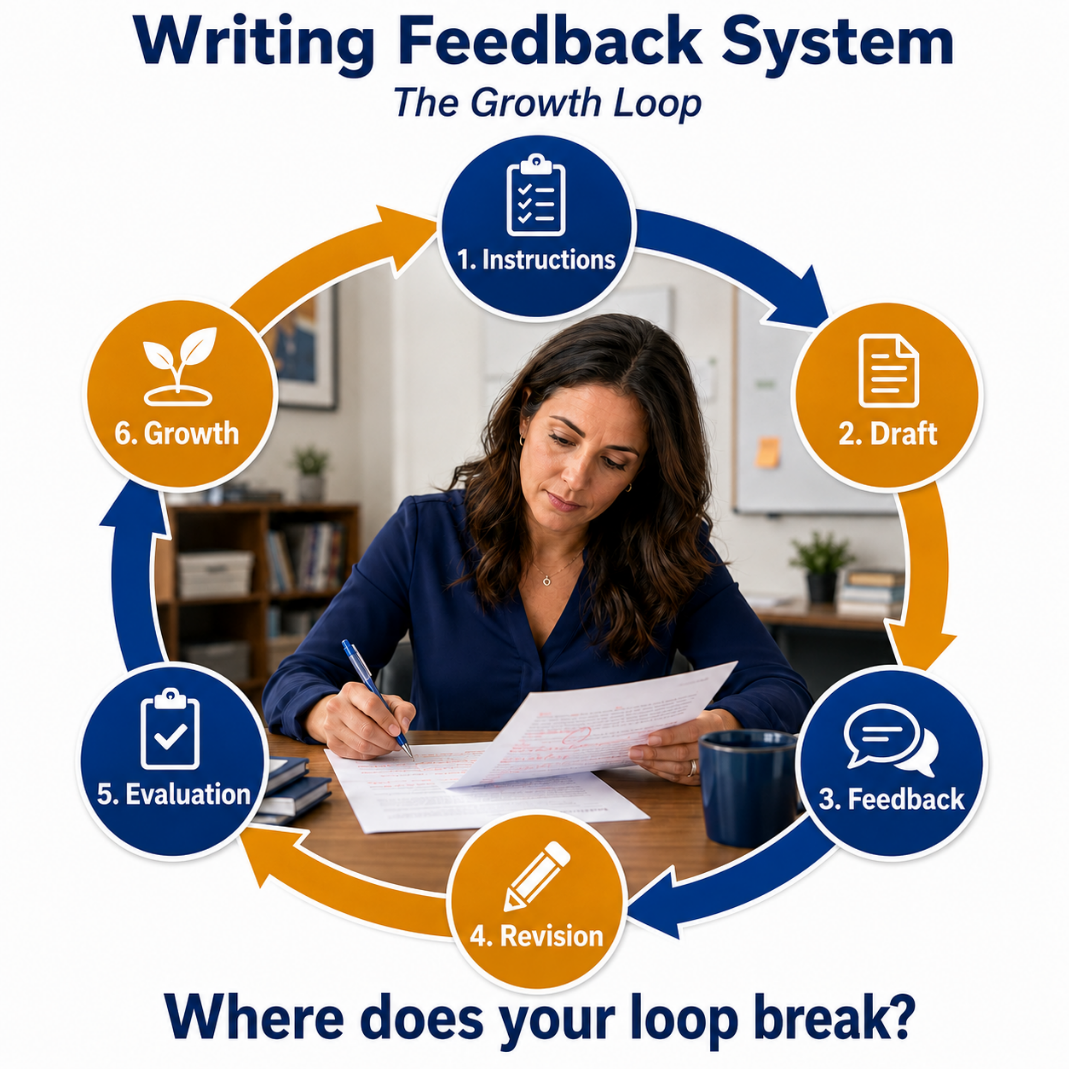
Teachers who report consistent revision behavior from students share one structural feature: revision is not a separate step that happens after writing. It is part of the writing sequence itself.
That means feedback arrives while the draft is still open, not after it has been submitted and graded. It means students are expected to respond to that feedback before moving forward, not after receiving a score. And it means the teacher can see whether revision happened, not just whether a new draft was submitted.
Draft history matters here. A student who submits a “revised” draft that is 95% identical to the original has not revised. A teacher who can compare drafts side by side knows this immediately. A teacher working from memory or a stack of papers does not.
The ACT Writing Problem
For schools where ACT performance is an institutional priority, revision habits have a direct score relationship. The ACT Writing rubric assesses four domains: Ideas and Analysis, Development and Support, Organization, and Language Use. Three of those four domains reward exactly the behaviors that substantive revision builds: developing an argument, supporting it with evidence, and organizing it coherently.
Students who have never been required to revise an argument do not suddenly produce strong analytical writing under timed test conditions. The ACT writing score reflects a writing process, not just a writing moment.
Practical Starting Points for Teachers
- Separate feedback from grading. When feedback arrives on a draft that has already been graded, students read the grade and stop. Feedback on ungraded drafts produces more revision behavior.
- Make revision comparison visible. Ask students to highlight what changed between drafts and explain why. The explanation requirement forces conscious engagement with the revision decision.
- Build revision into the sequence, not onto it. If revision is a phase students must complete before a draft is considered finished, it stops being optional. Structural positioning changes behavior more reliably than encouragement.
- Reduce the feedback lag. The longer the gap between draft submission and feedback, the less revision results. Any system that compresses that window—peer review, structured self-assessment, or technology-assisted feedback—produces more substantive revision.
- Define revision explicitly. Post the distinction between surface editing and substantive revision. Make it visible. Students cannot aim at a target they cannot see.
The Through Line
Revision does not fail because students are lazy or indifferent. It fails because most writing workflows do not require it, do not make it visible, and do not return feedback fast enough to act on. The teachers who crack this problem are not doing something inspirational—they are doing something structural.
The fix is not a better comment on a returned paper. The fix is a process where revision is expected, supported, and visible before the work is done.
Sources referenced: George Hillocks Jr., Research on Written Composition (1986); John Hattie and Helen Timperley, “The Power of Feedback,” Review of Educational Research (2007).