Schools that take ACT preparation seriously have a familiar pattern: they invest heavily in math and reading intervention, they track score movement closely, and they celebrate when multiple choice scores climb. Then someone pulls the writing scores. The room gets quiet.
ACT writing scores have remained flat or declined at schools across the country even as multiple choice performance improves. This is not a coincidence. It reflects something structural about how writing is taught, how writing is practiced, and how writing performance is assessed in most secondary schools.
What the ACT Writing Section Actually Tests
The ACT Writing test gives students 40 minutes to respond to a prompt that presents a contemporary issue and three perspectives on it. Students are expected to develop their own perspective, analyze the relationship between their perspective and the three provided, and support their argument with evidence and reasoning.
The test is scored on four domains: Ideas and Analysis, Development and Support, Organization, and Language Use and Conventions. Each domain is scored on a 1–6 scale by two raters; scores are averaged. A student who produces a grammatically clean essay with a weak argument will score poorly. A student who constructs a strong argument with surface-level errors will outscore her.
That scoring logic has direct instructional implications. Grammar instruction does not move ACT writing scores. Argument construction does.
Why Multiple-Choice Gains Don’t Transfer
Multiple choice ACT preparation typically focuses on content knowledge, reading comprehension, and test-taking strategy. Those are teachable, measurable, and responsive to targeted intervention. Schools that commit to structured test prep see results.
Writing does not work the same way. You cannot drill your way to a stronger argument. A student who has never been required to analyze competing perspectives, build a line of reasoning, or support a claim with evidence cannot produce that work under timed conditions regardless of how many practice prompts she completes without feedback.
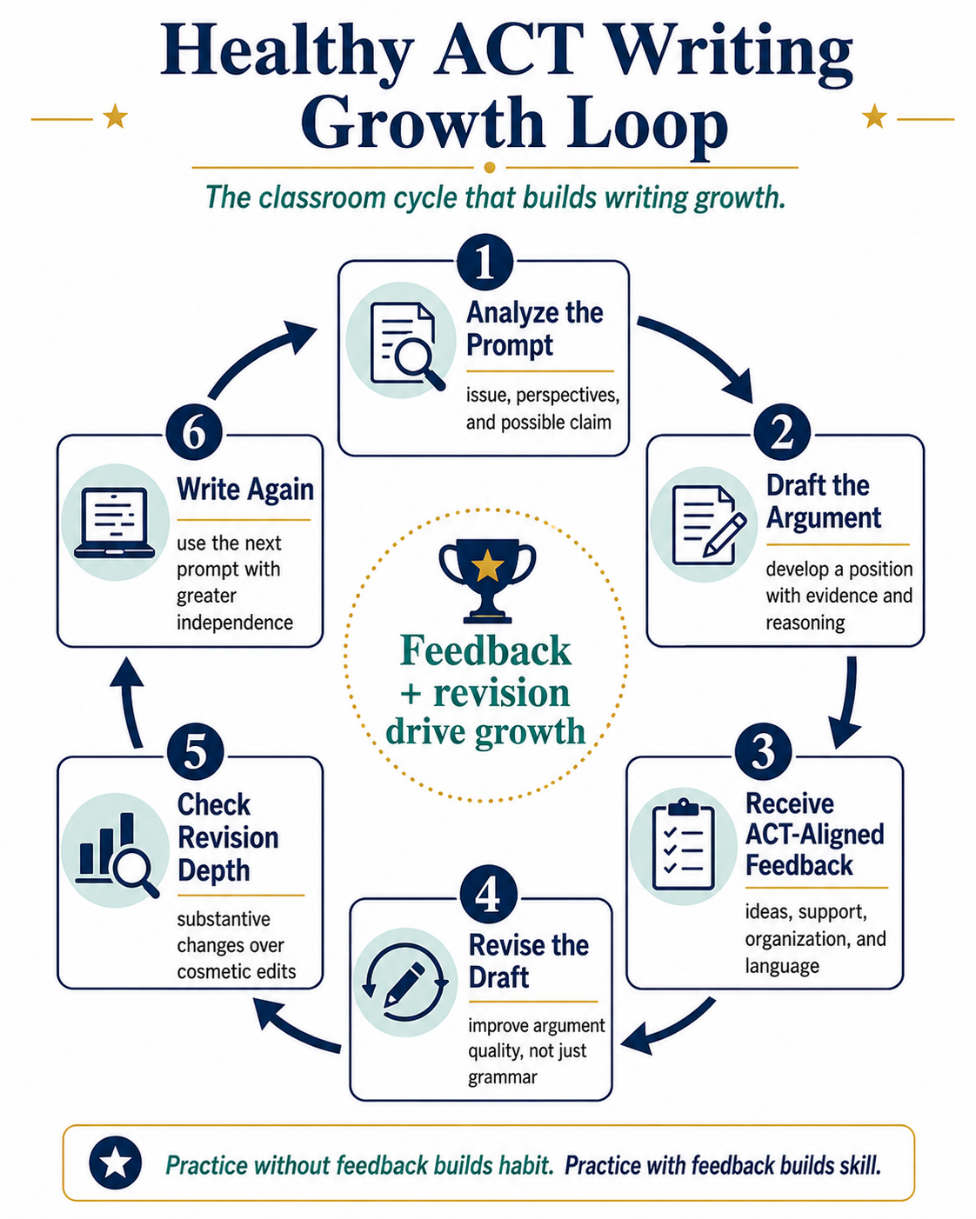
Practice without feedback does not build skill. It builds habit, and in writing, the habits students bring to the ACT are exactly the habits their years of writing instruction produced. If those habits do not include argumentation, evidence analysis, and revision, the test will expose that gap every time.
The Feedback Problem
Here is the core issue: writing improvement requires feedback that arrives quickly enough to act on, connects clearly to the criteria being assessed, and creates an expectation of revision. Most high school writing instruction fails to deliver these consistently.
A typical high school ELA teacher carries 100–130 students. Providing meaningful written feedback on a full draft takes 10–15 minutes per student. At that rate, a single round of feedback on one assignment consumes more than an entire planning period, or even a week’s worth of planning periods. Teachers make rational choices under that constraint—they reduce the frequency of extended writing assignments, simplify feedback, or both.
The result is that most students graduate having written fewer extended arguments than the ACT writing section requires them to produce in 40 minutes, with less structured feedback on their argumentation than the rubric demands, and with no consistent experience of revising an argument rather than a surface edit.
What the Score Gap Is Actually Measuring
When a school shows meaningful improvement in ACT multiple choice grade-level equivalency and flat or declining writing scores, the data tells a specific story. The school has successfully addressed the content and strategy side of the test. It has not addressed the writing process side.
The writing score gap does not measure student intelligence or effort. It measures the cumulative effect of years of writing instruction that did not prioritize argument construction, structured feedback, or revision cycles. That is an instructional system problem, not a student problem.
This distinction matters for how schools respond to the gap. Purchasing more test prep materials addresses the wrong problem. Changing the writing instruction system addresses the right one.
What Closing the Gap Requires
The schools that close the ACT writing gap share a set of instructional features that are not complicated but are consistently absent from standard practice.
- Students write extended arguments regularly, not occasionally. Frequency matters because argument construction is a skill that degrades without practice.
- Feedback is tied to the four ACT domains, not generic writing quality. Students improve on the criteria they are assessed against. If feedback does not reference Ideas and Analysis or Development and Support, students do not develop those capacities.
- Revision is required, not optional. A student who submits a draft and receives feedback has not yet done the most important work. Revision against specific criteria is where score-relevant learning happens.
- Timed practice follows untimed practice. Students who have never written a structured argument without scaffolding will not produce one under time pressure. The sequence matters: build the skill first, then test it under conditions.
- Teachers can see revision depth, not just final drafts. A teacher who can compare draft one to draft two—and see whether changes were substantive or cosmetic—has information that a teacher reading only final submissions does not.
The Institutional Stakes
ACT writing is not a peripheral concern for most secondary schools. It appears on state report cards, factors into accountability ratings, and sits in plain view during administrator reviews. A school with strong multiple-choice performance and flat writing scores has a visible, documentable gap that the standard intervention playbook does not address.
Closing that gap requires treating writing instruction as a system—with structured practice, rubric-aligned feedback, revision requirements, and teacher visibility into the process—rather than as a subject covered in ELA class. Those are different things. The schools that recognize the difference are the ones that move the score.
The ACT Writing rubric and scoring criteria are published by ACT, Inc. at act.org. Score interpretation data referenced reflects aggregate reporting from state ACT participation programs.