Most middle school AI policies share the same architecture: a prohibition, an honor code, and a detection tool held in reserve. The standard is written. The enforcement is reactive. What happens between the assignment and the submission is invisible to the teacher.
That invisibility is the problem. Prohibition without visibility is a standard without infrastructure. It asks students to make a compliance decision in a context where the decision is unobservable and the consequences are uncertain. That combination does not produce reliable behavior in adults, and it does not produce it in sixth graders either.
The framing of the AI integrity problem as a prohibition problem misdirects the institutional response. The question is not how to make students stop using AI. The question is how to design instructional contexts where what students do during writing is visible enough to assess, bounded enough to remain educationally productive, and connected to a process the teacher can respond to.
What Visibility Actually Changes
When teachers have access to the writing process — draft history, revision patterns, the sequence of student decisions — the integrity conversation changes in two specific ways.
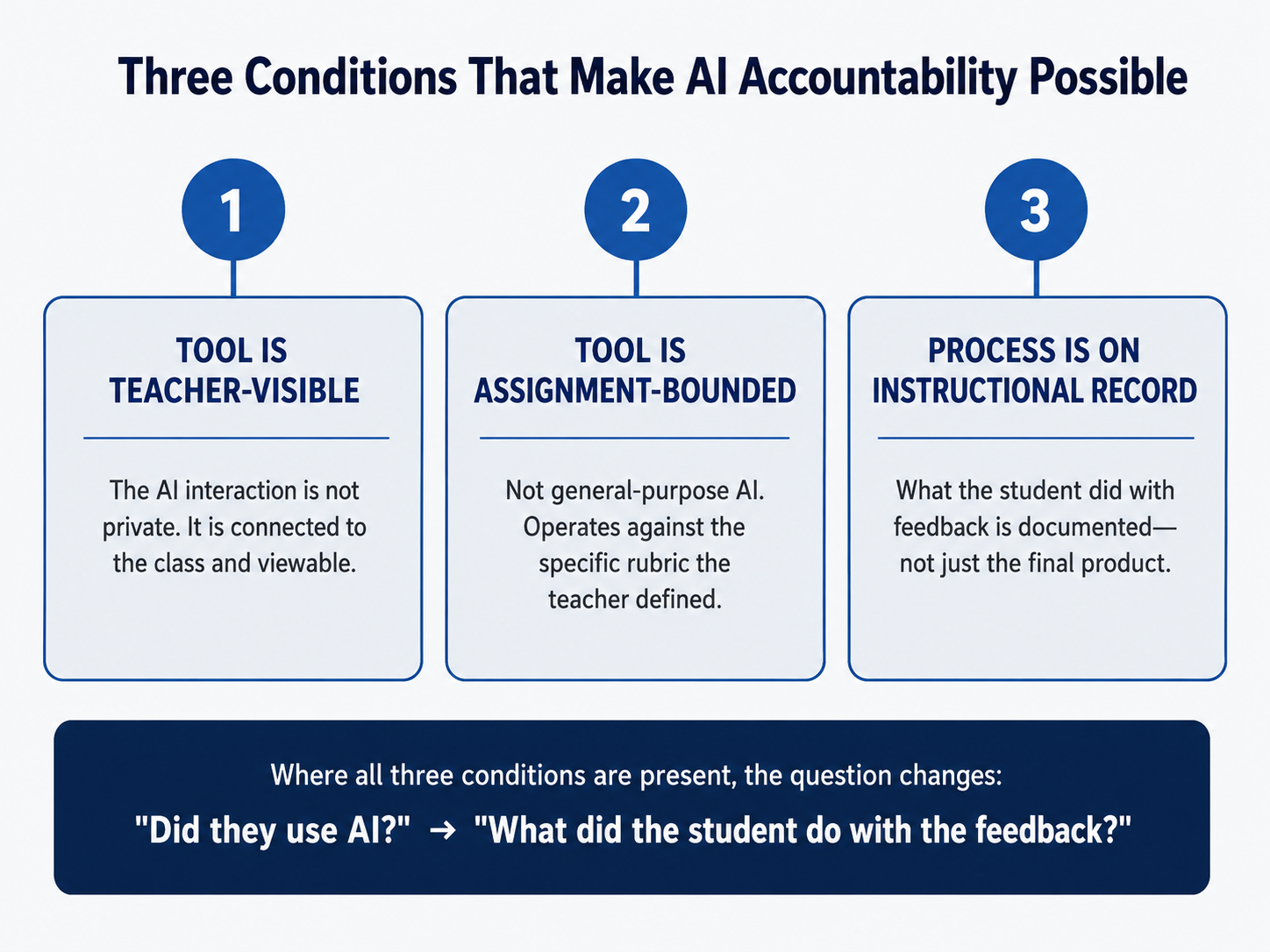
First, it changes the question. The relevant question shifts from “did you use AI?” — a question a student can answer falsely — to “show me how this draft changed and why.” A student who has done the work can produce a revision history with specific decisions at each stage. A student who submitted an AI-generated product cannot fabricate that history without, effectively, doing the work. The question with a verifiable answer replaces the question with an honor-code answer.
Second, it changes the cost structure for the student. When the writing process is invisible, AI use is low-risk from the student’s perspective: the upside is a better product with less effort, and the downside depends on detection, which is unreliable. When the process is visible, the calculus shifts. A student who wants to submit AI-generated work must also produce a plausible process record — a history of drafts, revision decisions, and responses to feedback that looks like genuine engagement. In most cases, that is harder than doing the work.
Paul Black and Dylan Wiliam’s Inside the Black Box, the landmark synthesis of formative assessment research, identified process transparency as one of the primary mechanisms through which feedback produces learning gains. A teacher who can see the writing process can deliver feedback when it matters — during the development of the draft — rather than after the work is done. A teacher who sees only a finished product can assess it. She cannot intervene in it.
The Architecture That Produces Visibility
Visibility is not a policy feature. It is an architectural feature of the assignment infrastructure. A teacher who assigns a paper through a general word processor, collects it via email, and reviews a single final draft has no process visibility regardless of how detailed the AI policy is.
Assignment infrastructure that produces genuine visibility has four structural properties, none of which are behavioral. The tool is school-governed rather than student-initiated: the teacher controls what tool is used, under what configuration, and in what context. The tool is class-linked: teacher access to student work is automatic and does not depend on student disclosure. The tool is assignment-bounded: student work stays within the scope of the task the teacher configured, rather than extending to whatever the student wants to ask a general-purpose AI to do. The tool preserves draft history: the teacher can see how the final product developed, what changed across revision cycles, and what feedback the student received and responded to.
These are design conditions, not behavioral conditions. They cannot be approximated by policy language. A school that has written a strong AI prohibition policy but deployed no governed alternative has raised the standard without providing the infrastructure to support it.
Why Middle School Specifically Requires This Architecture
The visibility problem has particular consequences at the middle school level because of what middle school writing instruction is supposed to produce.
Grades 6 through 8 are where students build foundational frameworks for argument construction, evidence evaluation, and substantive revision. A student who bypasses this developmental work by submitting AI-generated writing does not fall behind. She fails to develop the foundational skills in the first place. The high school teacher who inherits that student does not have a student who is developing slowly. She has a student who has not begun.
Arthur Applebee and Judith Langer’s 2011 national study of writing instruction found that middle school students who received structured process-based writing instruction — assignments that made drafting, feedback, and revision visible and required — produced significantly more complex arguments at the end of the unit than students who completed the same assignment without process structure. The process visibility was not incidental to the learning outcome. It was what produced it.
The RAND Corporation’s 2023–2024 survey of K–12 teachers found that teachers’ primary AI concern is not technology opposition. It is accountability. Teachers want a way to know whether the work students submit reflects the thinking those students actually did. That is a process visibility question. It cannot be answered by examining a product.
Practical Starting Points for Teachers
- Establish a process record requirement for every extended writing assignment. A brief end-of-draft reflection — what the student changed between drafts and why — creates a process artifact that product assessment alone cannot provide. It is also a diagnostic: a student who cannot articulate revision decisions she made has either not made them or cannot explain them, and both are instructionally useful to know.
- Require first drafts before final submissions. The comparison between a first draft and a final draft is the simplest visibility mechanism available. A student who submits two nearly identical documents has provided more information about the revision process than a student who submits only a polished final version.
- Distinguish between class-governed and student-initiated tool access. The former creates accountability. The latter does not. A policy that addresses only student-initiated access leaves the governance gap open, because the student’s decision still happens in an unobservable context.
- Use in-class writing as calibration. A brief in-class writing sample on the same assignment topic creates a comparison document. A student whose in-class writing is substantially different in quality from her submitted final draft has provided a data point worth investigating. This is not surveillance — it is standard instructional practice in every other domain.
The Through Line
The AI integrity problem in middle school writing is not a compliance problem. It is a visibility problem. Prohibition without visibility produces an honor-code environment where the decision to use AI is unobservable and enforcement is reactive, unreliable, and adversarial. Visibility-based assignment design produces an environment where the process is part of the record, the question shifts from “did they cheat” to “what did they actually do,” and the teacher is positioned to answer it.
The solution is architectural. A school that wants to address AI integrity in middle school writing needs assignment infrastructure that makes process visible — not a better detection tool applied to products that have already been submitted.
Sources referenced: RAND Corporation, “K–12 Teachers’ Experiences With Artificial Intelligence” (2023–2024); Black, P. & Wiliam, D., Inside the Black Box (King’s College London, 1998); Applebee, A.N. & Langer, J.A., “A Snapshot of Writing Instruction in Middle Schools and High Schools,” English Journal (2011); Common Sense Media, AI and Teens (2023).