A high school English teacher with five sections of 25 students has 125 students. Meaningful written feedback on a single draft: the kind that names a specific weakness in the argument, connects it to the rubric criteria, and gives the student a clear direction for revision, takes roughly 10 to 15 minutes per paper. That is between 20 and 31 hours of feedback time for one round of one assignment.
No one has that amount of time. The rational response is to do less: fewer extended writing assignments, faster turnaround that trades depth for speed, or shorter feedback that covers the most visible problems and leaves the rest. All three produce the same outcome: students write less often and with less specific guidance than writing improvement requires.
That is the 125-student bottleneck. It is not a teacher failure. It is a structural constraint that determines what writing instruction looks like in most secondary schools, and it does not yield to effort or good intentions.
What Happens When Feedback Volume Drops
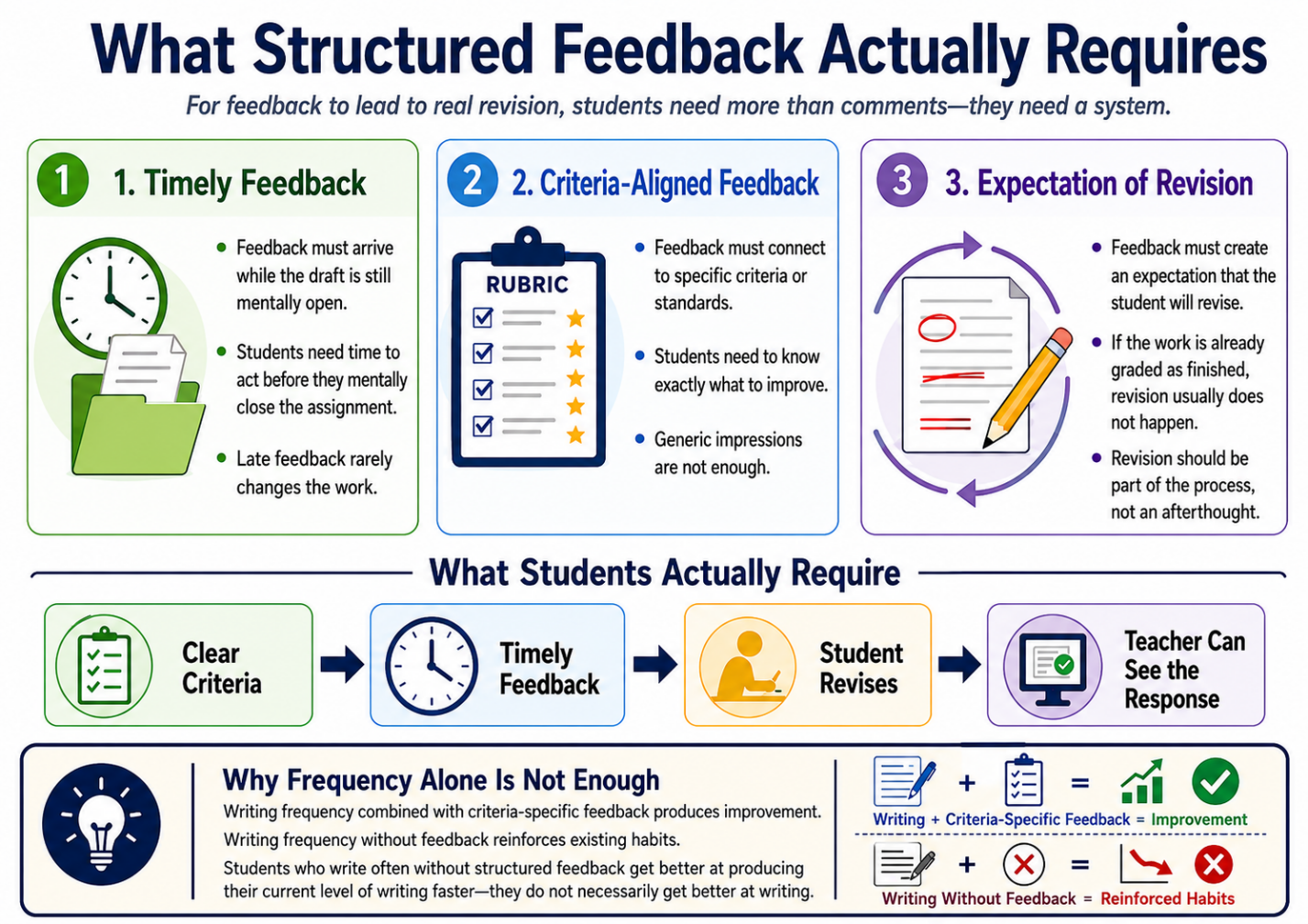
Writing is a volume game. Research on skill acquisition in writing, from George Hillocks Jr.’s 1986 synthesis to more recent composition pedagogy, consistently shows that writing frequency combined with criteria-specific feedback produces improvement. Writing frequency without feedback reinforces existing habits. Students who write often without structured feedback get better at producing their current level of writing faster. They do not get better at writing.
When the feedback bottleneck reduces assignment frequency, students write less. When it reduces feedback quality, the writing they produce does not improve on the dimensions that matter for high-stakes assessment. Both outcomes are measurable in ACT writing scores, college readiness data, and the gap between what students can produce on a rough draft and what they submit as a final product.
What Structured Feedback Actually Requires
Structured feedback that produces revision has three components. It has to arrive while the student’s draft is still mentally open, meaning within a window where the student can act on it without having mentally closed the assignment. It has to connect to specific criteria, not generic impressions, so the student knows what to improve and by what standard. And it has to create an expectation of revision: feedback that arrives on a document the student has already been graded on rarely produces revision behavior.
None of those three conditions requires a teacher to write every comment from scratch on every draft. They require a system that can deliver criteria-aligned feedback at volume and that makes the student’s response to that feedback visible to the teacher.
How the Bottleneck Gets Addressed
Guided Scholar’s Coach Me mode changes the workflow. A student submits a complete draft. The system delivers rubric-aligned feedback tied to the specific assignment criteria. The student revises and resubmits. The teacher sees the original draft, the feedback, and the revised draft side by side, with revision depth flagged, distinguishing a substantive thesis rewrite from a comma correction.
The teacher does not write every feedback comment from scratch. The system does that work at scale, anchored to the rubric and the teacher’s specific assignment. The teacher’s attention shifts from generating feedback to reading revision: deciding where the student’s response to feedback was substantive, where it was surface-level, and where direct intervention is still needed.
That is a different use of 10 to 15 minutes. Instead of writing comments on a draft the student may or may not read, the teacher is evaluating what the student did with the feedback, which is the instructional information that informs next steps.
66 of 66 essays within one point of human-graded scores across six sets of essays. That is not a proxy for teacher judgment. It is an anchor that keeps automated feedback tied to the criteria the assignment actually asked for.
What Teachers Get Back
The shift is not about reducing teacher involvement. Teachers who use this structure are more engaged in the revision process than teachers in standard one-draft workflows, because they can see what happened between drafts rather than evaluating a final product in isolation.
What changes is where the time goes. A teacher who can identify within two minutes which students revised substantively, and which revised cosmetically does not need to re-read every draft from scratch. She can direct her limited feedback time at the students who need it most: those whose revisions reveal a deeper misunderstanding of the argument requirements, not those who fixed a comma and called it done.
Draft history visibility is the mechanism. A teacher who can see the original draft, the feedback, and the revision in one view has information that a teacher reading only final submissions does not. That information changes what feedback is necessary, who receives it, and what form it takes.
The Through Line
The 125-student bottleneck is real, and it is not going away. The question is not whether teachers can eliminate the constraint but whether a system exists that lets them work within it and still deliver the feedback conditions that produce revision. The answer is yes, but it requires rethinking what teacher feedback time is for and what the system around the teacher is doing.
Feedback that produces writing improvement is criteria-specific, timely, and connected to a visible revision requirement. Delivering that at scale does not mean the teacher disappears from the process. It means the system handles the volume work and the teacher handles the judgment work. That division produces better outcomes than a single teacher trying to do both for 125 students at once.
Sources referenced: George Hillocks Jr., Research on Written Composition (1986); ACT, Inc., Writing rubric and scoring criteria (act.org).