A teacher assigns a research presentation and tells her students to limit themselves to fifteen slides. Most produce fifteen slides of topic-organized bullets: five covering background, five on current developments, five on implications. Each slide has a heading and three to five bullets. The bullets are accurate. The slides are organized. There is no argument anywhere in the deck.
The students misunderstood the assignment, but not in the way the teacher thinks. They understood correctly that they were supposed to produce fifteen slides. What they did not understand is that the slides are a medium, not the deliverable. The deliverable is an argument. The slides carry it. Most students at the secondary level have never been taught the difference.
What Presentation Slides Are Actually For
Slides serve two functions in an argument-centered presentation. They provide visual evidence that advances the claim, such as data, images, or diagrams that show what the spoken argument is arguing from. And they serve as navigation markers for the audience, signaling where in the argument’s structure the presentation currently is.
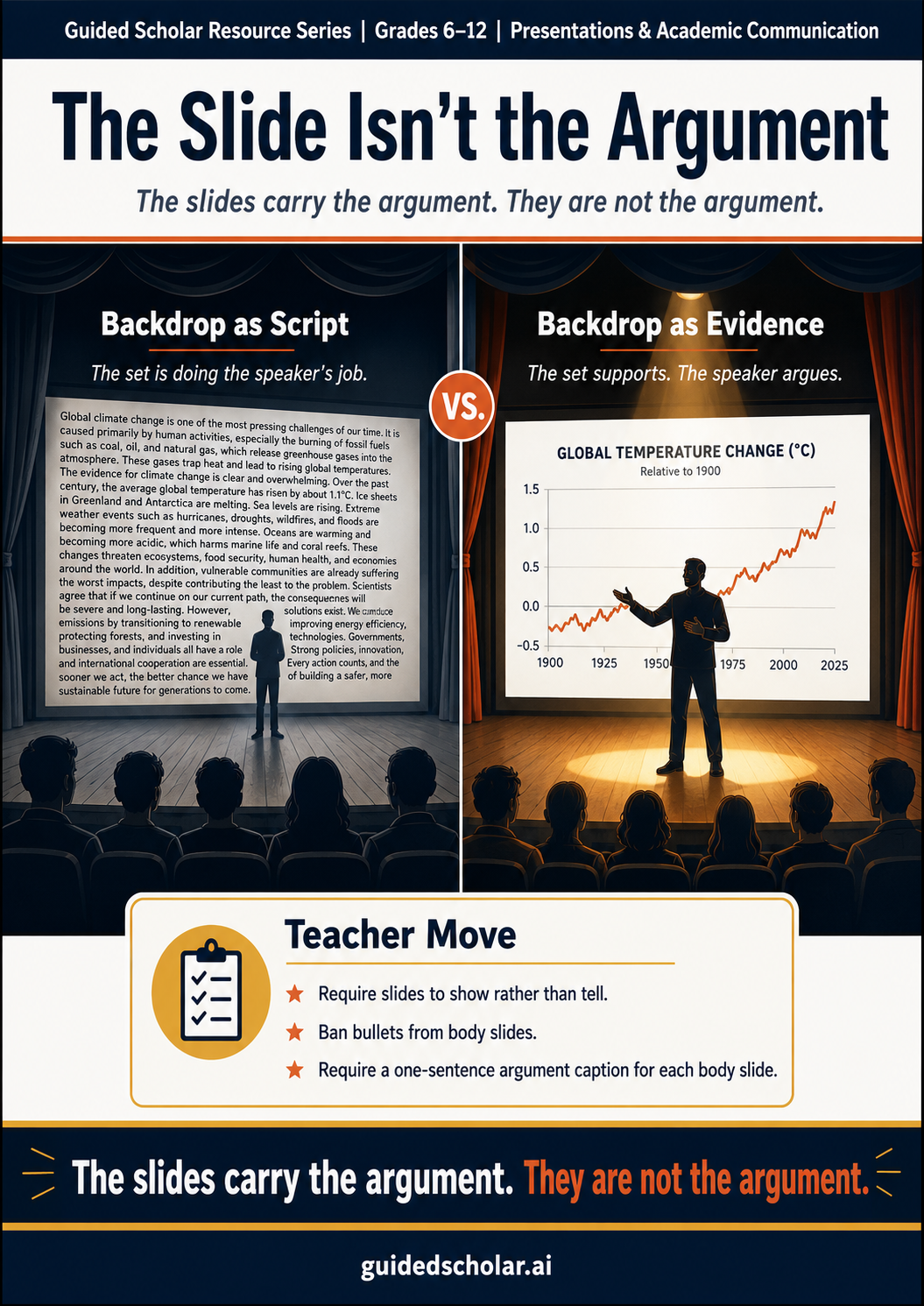
Neither function requires bullets. A slide that shows a graph while the speaker explains what the graph establishes is doing both jobs well: the visual provides evidence, and the spoken argument explains what it means. A slide that lists five facts in bullets while the speaker reads them aloud is doing neither. The visual is carrying the argument that should be spoken, and the spoken content is duplicating the visual rather than developing it.
The Bullet Point Problem
Bullet points are an information organization format. They work for lists of parallel, discrete items where no item is more important than another and where the relationship between items is additive. They do not work for argument because argument depends on logical sequence and the connections between ideas, and bullets remove connections by design.
Consider the difference. An argument in sentence form: “social media reduces political engagement because platforms optimize for emotional response, which crowds out deliberate reasoning, as evidenced by the correlation between heavy platform use and declining participation in local governance.” Broken into bullets, the same content becomes three separate points. The causal chain that made it an argument is gone. Students who fill slides with bullets are not failing to be persuasive. They are choosing a format that structurally cannot carry an argument.
What Argument-Centered Slide Structure Looks Like
An argument-centered presentation opens by stating the claim, not introducing the topic. “Today I will discuss social media and political engagement” introduces a topic. “Social media’s optimization for emotional response is producing a measurable decline in the deliberate reasoning democratic participation requires” states a claim the audience is being asked to accept.
Each subsequent slide advances a specific aspect of the argument. One slide establishes the mechanism. The next presents evidence for the consequence. A third addresses the strongest objection. The slide sequence serves the argument. It does not organize the topic. This structure is not harder to produce than topic-organized bullets. It requires a claim. A student who has a specific claim she is trying to establish can organize slides in service of it. A student who does not have a claim cannot.
The Research Context
Richard Mayer’s cognitive theory of multimedia learning, developed in Multimedia Learning (2001), established that visual and auditory processing channels have separate and limited capacity. When the same content appears in both channels simultaneously, both are overloaded without gaining information. When the visual channel carries evidence and the auditory channel carries the spoken argument that develops it, both channels are used to full capacity on complementary content.
The practical instructional implication is direct: slides that contain only text are carrying the argument that should be spoken. A student who puts her entire argument in bullets has eliminated the spoken argument from the equation. The presentation becomes a reading exercise the audience could perform faster and more accurately without her.
Practical Starting Points for Teachers
- Require slides to show rather than tell. Each slide should present a visual, a data table, a photograph, a diagram, or a single key quote, that the spoken argument will interpret. Slides containing only text are carrying the argument that should be spoken.
- Ban bullets from body slides. This constraint forces students to identify what visual evidence they need rather than what information they have. A student who cannot identify a visual for a section probably does not have evidence for that part of the argument.
- Require a one-sentence argument caption for each body slide. One sentence explaining what this slide establishes in the context of the overall argument forces the evidence-to-claim connection that bullets do not require.
- Model a topic-organized deck and an argument-organized deck side by side. Show two versions of the same presentation. Ask which is more persuasive and why. The comparison makes the structural difference concrete before students must produce it.
- Score argument structure separately from design and delivery. The criterion: does this slide do specific work in the development of the presentation’s claim? A visually polished slide that adds no argumentative content should score lower than a plain slide that advances the argument clearly.
The Through Line
The slide deck is the medium. The argument is the deliverable. Students who have been taught to build presentations by filling slides with bullets have been taught to produce organized information deliveries, not arguments. The instruction that changes this asks the same question that drives every other aspect of academic communication: what is the specific claim, and what evidence develops it? In a presentation, the evidence is visual. The claim is spoken. The reasoning that connects them is what the presentation is for.
Sources referenced: Mayer, R., Multimedia Learning (Cambridge University Press, 2001); Atkinson, C., Beyond Bullet Points (Microsoft Press, 2007); Hillocks, G., Teaching Argument Writing, Grades 6–12 (Heinemann, 2011).