Read five paragraphs from a typical sixth grader and a pattern appears almost immediately. Subject, verb, object. Subject, verb, object. The student is not wrong, exactly. Every sentence is grammatically complete. But the writing reads like a list, not an argument, because every sentence carries the same weight and the same shape.
This is not a grammar problem. Students who write only simple sentences usually know how to build a complex one when asked directly, in isolation, on a worksheet. The problem is that nothing in their daily writing requires them to vary structure, so the simple sentence becomes the default and stays the default well into high school, surfacing again in eleventh-grade essays that read exactly like sixth-grade ones, just with longer words.
Why the Pattern Forms
Sentence-level writing instruction in most middle school classrooms focuses on correctness: subject-verb agreement, fragment avoidance, run-on correction. None of that instruction asks a student to combine two short sentences into one, or to open a sentence with a subordinate clause instead of the subject. Correctness and variety are different skills, and only one of them gets taught directly, year after year, while the other is assumed to develop on its own.
Students default to the safest sentence shape because it is the one least likely to be marked wrong. A short, simple sentence is easy to check for completeness. A sentence that opens with a dependent clause, embeds a modifier, or coordinates two independent clauses introduces more places for an error to occur, a missing comma, a misplaced modifier, a comma splice, so students who are writing for a grade avoid the risk and stay inside the safest structure they have.
The result compounds over the school year. A student who avoids complex sentences in September because the structure feels risky has, by May, simply never practiced it. The avoidance is not a one-time choice; it is a habit that gets reinforced every time the simple sentence comes back with a passing grade and the complex one never gets attempted at all.
A Concrete Example
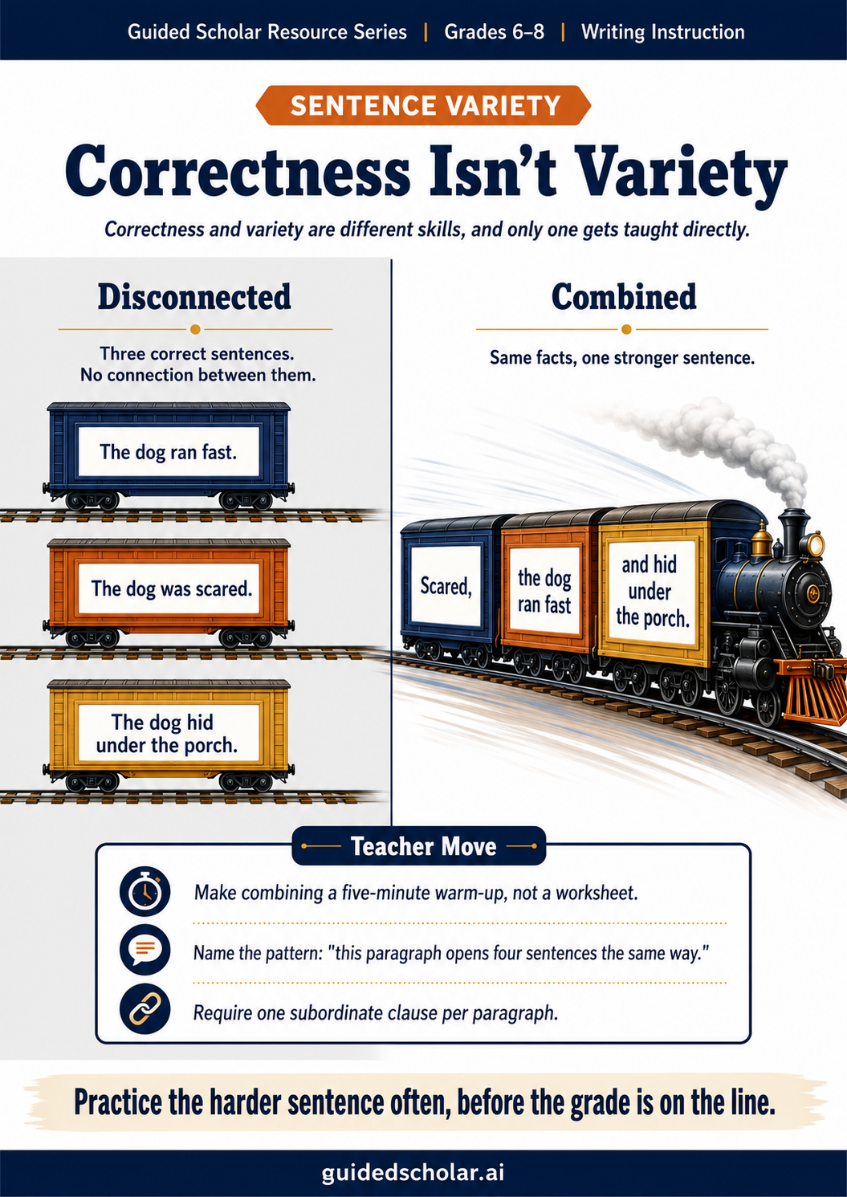
A seventh grader writes: 'The dog ran fast. The dog was scared. The dog hid under the porch.' Three correct, complete sentences, and a teacher marking only for correctness has nothing to flag. Combined, the same content reads: 'Scared, the dog ran fast and hid under the porch.' One sentence, one subordinate structure, the same facts, and a noticeably stronger piece of writing.
The difference between the two versions is not vocabulary or idea quality. The student already had the content. What changed is the willingness to risk a more complex structure, which is exactly the skill sentence-combining practice builds and exactly the skill that correctness-only feedback never asks for.
What the Research Shows
Steve Graham and Dolores Perin's 2007 meta-analysis Writing Next, conducted for the Alliance for Excellent Education, reviewed the available experimental writing research and identified sentence combining as a distinct, effective writing instruction practice, separate from and more effective than traditional grammar study. Traditional grammar instruction taught in isolation, parsing sentences, labeling parts of speech, diagramming structure, showed minimal to negative effects on writing quality across the studies reviewed, a finding consistent enough that the report treats it as one of its more confident conclusions.
Bruce Saddler and Steve Graham's 2005 study in the Journal of Educational Psychology tested this directly with young writers. Peer-assisted sentence-combining instruction improved the writing performance of both more and less skilled students, with measurable gains in syntactic complexity that simple grammar drills did not produce. The students were not taught a rule and asked to recite it. They were given short, related kernel sentences and asked to combine them, repeatedly, with a partner checking the result.
The mechanism behind both findings is the same. Students who practice combining kernel sentences into more complex structures build the skill through repetition and feedback, not through being told the rule and trusted to apply it independently. Knowing that a subordinate clause exists is not the same skill as reaching for one under the pressure of a real writing task.
What This Looks Like in Guided Scholar
Coach Me mode surfaces sentence-level feedback tied to the specific rubric criterion being assessed, flagging passages where every sentence shares the same opening structure or length. The student sees the pattern named specifically, 'this paragraph opens four sentences in a row with the subject,' not a general note to 'vary sentences' that gives no foothold for revision.
Because revision is available rather than mandatory, a student can work through two or three feedback cycles on a single paragraph's sentence variety without losing access to the rest of the draft. The practice happens inside the actual writing task, in the section where the pattern appeared, rather than in a separate worksheet disconnected from anything the student is currently trying to say.
Practical Starting Points for Teachers
- Make combining a warm-up, not a worksheet. Give students two short, related kernel sentences and five minutes to combine them three different ways before the writing task begins. The exercise takes less time than a bell-ringer and builds the exact skill the day's writing will require.
- Name the pattern when you see it. Telling a student 'this paragraph is four subject-verb-object sentences in a row' is more useful than a general note to vary sentence length, because it points at something the student can find and fix without guessing what you meant.
- Require one subordinate clause per paragraph. A small, concrete constraint forces structural variety without requiring a full grammar unit, and it is specific enough that students can self-check before turning in a draft.
- Read drafts aloud. Repetitive sentence rhythm is often more audible than visible; students catch the pattern faster by ear than by eye, especially when the repetition is their own writing read back to them.
The Through Line
Sentence variety is not a polish step added at the end of the writing process, after the ideas are settled and the argument is built. It is a structural habit that has to be practiced the same way revision and argumentation are practiced, through repeated, low-stakes attempts with specific feedback, not through a single lesson on subordinate clauses delivered once and never returned to.
Students who only ever practice the safe sentence will keep writing the safe sentence, in sixth grade and in eleventh. The fix is giving them a reason, and a low-risk place, to try the harder one, often, and before the grade is on the line.
Sources referenced: Graham, S., & Perin, D., Writing Next: Effective Strategies to Improve Writing of Adolescents in Middle and High Schools (Alliance for Excellent Education, 2007); Saddler, B., & Graham, S., The Effects of Peer-Assisted Sentence-Combining Instruction on the Writing Performance of More and Less Skilled Young Writers, Journal of Educational Psychology, 97 (2005).