A teacher assigns a presentation on a policy issue and builds a rubric: eye contact, volume and pace, slide design, content coverage, and conclusion. The most persuasive presentation in the class scores 42 out of 50. The most fluently delivered presentation with the thinnest argument scores 47. The rubric has produced the correct outcome. It measured exactly what it was designed to measure. It was designed to measure the wrong things.
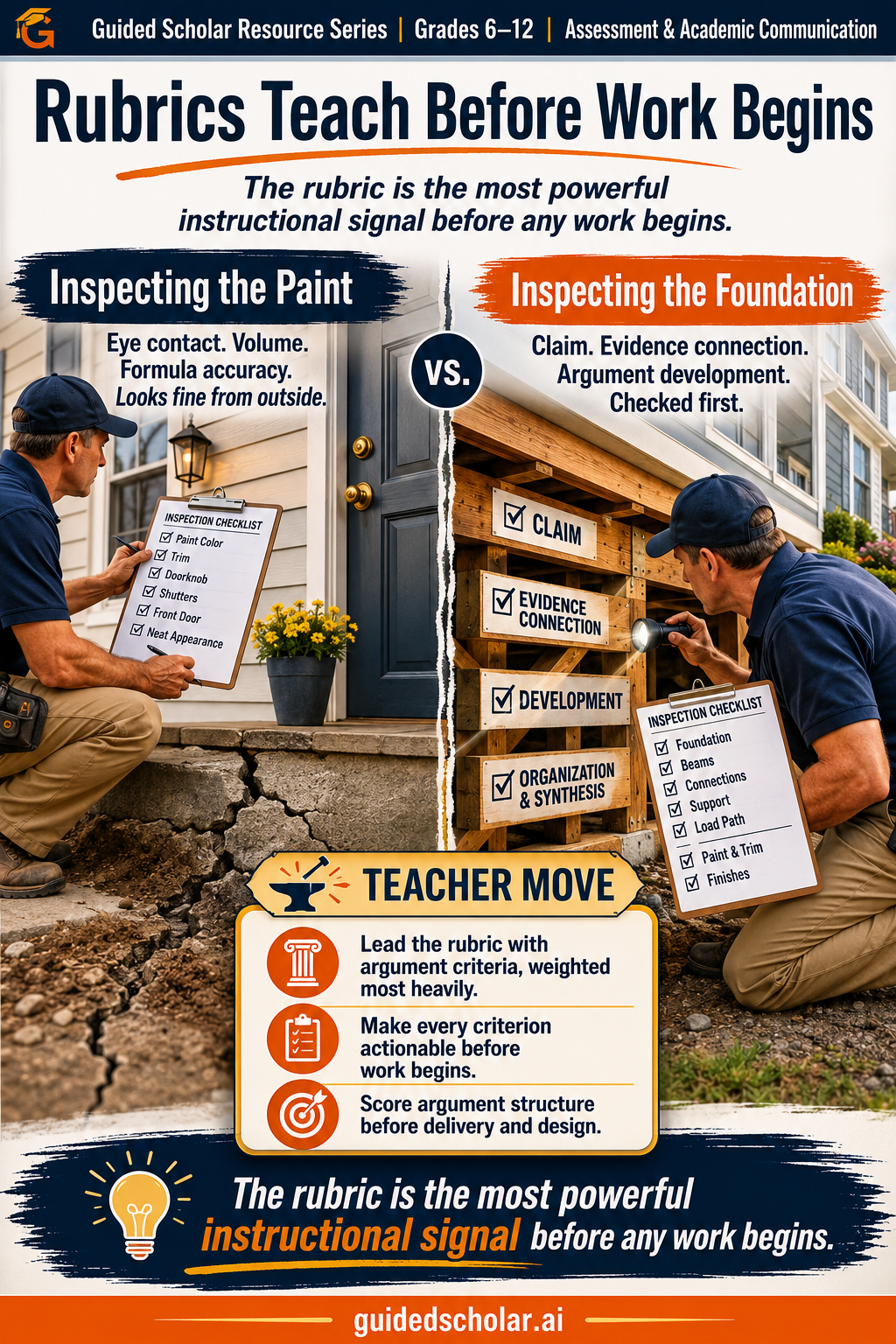
This is the rubric design problem for presentations and spreadsheets at the secondary level. Rubrics assess the visible, countable features of the work rather than the academic quality of the argument the work was supposed to make. The consequences are not incidental. The rubric is the most powerful instructional signal the teacher sends before a single slide is built or a single cell is entered. It tells students what the work is for.
What Most Presentation Rubrics Actually Measure
Standard secondary presentation rubrics consistently overweight delivery and underweight argument. A rubric allocating 40 percent of the score to eye contact, volume, and pace is telling students presentations are performances. A student who optimizes for the rubric will practice delivery. She will not practice her argument.
The argument-quality criteria that do appear in most presentation rubrics are typically vague. “Content coverage” assesses whether the student included relevant information. It does not assess whether she made a specific, arguable claim and developed it. “Organization” assesses whether the slides have a logical sequence. It does not assess whether that sequence serves an argument or organizes a topic. Both criteria can be satisfied by a well-organized information delivery. Neither requires an argument.
What Most Spreadsheet Rubrics Actually Measure
Spreadsheet rubrics at the secondary level typically assess technical accuracy (formulas are correct), completeness (all required data is entered), and formatting (the spreadsheet is readable). These criteria evaluate whether the assignment was completed. A student who builds a technically perfect spreadsheet with no written claim and no explanation of what the data means can score full marks on a rubric that assesses only technical execution.
The academic work the assignment was supposed to produce, the data argument, has no place in the rubric and therefore no place in the student’s preparation. When the rubric does not require a claim, students do not produce claims. They produce technically correct spreadsheets and wait for someone else to draw the conclusion.
Why the Rubric Is an Instructional Document
John Hattie’s synthesis of learning research in Visible Learning (2009) identified rubric clarity as a significant factor in student performance. Students who understand exactly what is being evaluated, in terms specific enough to guide preparation, outperform students working from vague criteria. “Content: 10 points” is vague. “Claim: the presentation makes a specific, arguable position that the evidence develops (10 points)” is actionable. Students can prepare for the second criterion. They can only guess at the first.
The rubric is not just evaluative. It is instructional. It communicates what the assignment is designed to produce before the student begins. A rubric built around delivery and completion teaches students that presentations and spreadsheets are technical tasks. A rubric built around argument quality teaches students that they are academic arguments in format. Both types of rubrics produce the results they were designed to produce.
What Argument-Centered Rubrics Look Like
An argument-centered presentation rubric organizes its criteria around the academic purpose of the work. Claim specificity: does the presentation make a specific, arguable position, or does it introduce a topic? Evidence connection: does each slide advance the argument with specific evidence, and is the connection between the evidence and the claim explained? Argument development: does the presentation build across slides, or does it organize information without developing a position?
An argument-centered spreadsheet rubric includes the technical criteria alongside communicative ones. Accuracy and completeness still matter and should be assessed. Added: claim statement (does the submission include a specific, arguable claim supported by the data?), evidence selection (does the student identify which data points support the claim and explain why?), and connection (does the written analysis explain what the data establishes rather than just describing what it shows?).
Practical Starting Points for Teachers
- Lead the rubric with argument criteria and weight them most heavily. Students work from the top of the rubric. If claim specificity and evidence connection appear first with the highest point values, students prioritize them before delivery and design.
- Make every criterion actionable before work begins. A student reading the rubric should know exactly what each criterion requires. If a criterion requires interpretation to apply, rewrite it until it is specific enough to guide preparation.
- Apply the same core argument criteria across formats. Claim specificity, evidence connection, and argument development assess the same cognitive skill in an essay, a presentation, and a spreadsheet analysis. Consistent language across formats builds a consistent understanding of what academic communication requires.
- Score argument structure before delivery and design. Evaluating the claim and evidence development before evaluating eye contact communicates what the work is primarily for. The order of scoring reflects the order of importance.
The Through Line
The rubric is the teacher’s most powerful instructional tool before any work is done. It communicates what the assignment is for, what preparation looks like, and what the final product should accomplish. A rubric organized around argument quality for presentations and spreadsheets teaches students that academic work is communicative work regardless of format. A rubric organized around completion and delivery teaches them it is not. That choice belongs to the teacher, and it is made in the rubric before the assignment is distributed.
Sources referenced: Hattie, J., Visible Learning (Routledge, 2009); Atkinson, C., Beyond Bullet Points (Microsoft Press, 2007); Hillocks, G., Teaching Argument Writing, Grades 6–12 (Heinemann, 2011).