A teacher assigns a presentation on environmental policy and watches what happens. Her students who produced strong written arguments in the previous unit create slide decks with clear headers and well-chosen images. She expects good presentations. What she gets are organized reports delivered aloud. The argument that was present in the essays is absent from the slides. The students who could write did not know how to present. The ones who could not write did not know that they could not.
This is the argument-first problem in student presentations: the quality of a presentation is directly downstream of the student’s ability to construct an argument, and no amount of presentation coaching can substitute for argument construction skill that was never developed. A student who cannot state a specific claim and develop it through evidence in writing cannot do so in a slide deck. The format changes nothing about the underlying cognitive task.
The Argument Foundation Problem
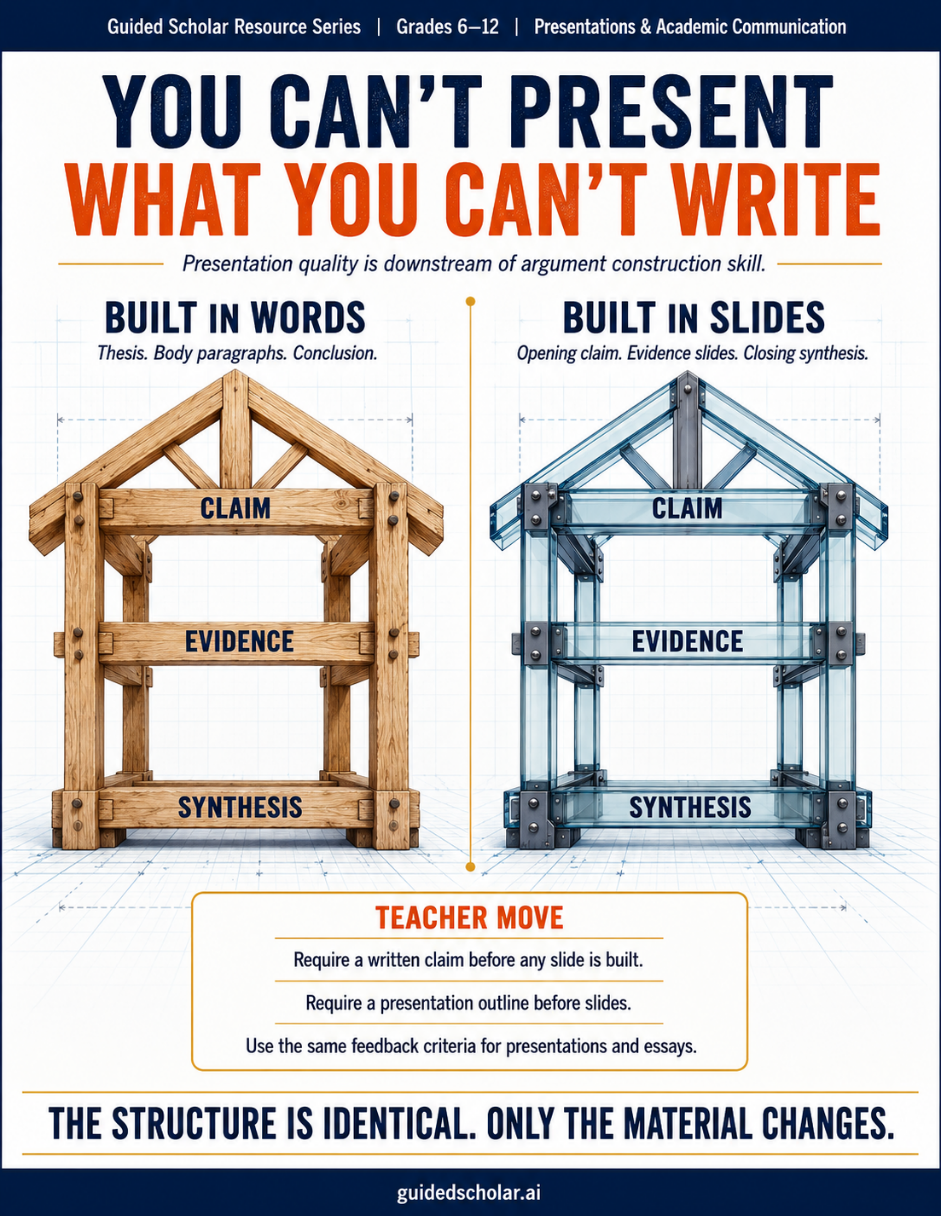
A written essay that constructs an argument has a thesis that makes a specific, defensible claim, body paragraphs that each develop a specific aspect of that claim through reasoning and evidence, and a conclusion that synthesizes rather than restates. These are not writing conventions. They are the structural requirements of any argument in any medium.
A presentation that constructs an argument has an opening slide that states a specific, defensible claim, supporting slides that each develop a specific aspect of that claim through evidence and explanation, and a closing slide that synthesizes rather than summarizes. The structure is identical. The medium is different. Students who have developed this structure in writing can transfer it to presentations with modest instruction in the format-specific differences. Students who have not developed it in writing cannot produce it in presentations, regardless of how much they practice speaking from slides.
What Happens When Students Build Slides Without a Claim
Most students, when assigned a presentation, open a slide program and start building slides. They create a title slide, an agenda slide, then slides for each subtopic they know about. The slides accumulate information. At the end of the process, the student has a deck of organized facts. She has not made an argument.
This is not the result of laziness or misunderstanding. It is the natural output of building slides before having a claim to develop. The student has not decided what she is arguing, so the slides cannot develop an argument. They develop the only thing that exists at that point: the topics the student knows something about. The fix is not better slide design. The fix is requiring the claim to exist before the first slide is built.
The Delivery Trap
The dominant form of presentation instruction at the secondary level focuses on delivery mechanics: eye contact, volume, pace, posture. These skills matter. They are also not what determines whether a presentation accomplishes its academic purpose.
A student who makes eye contact, speaks clearly, and paces herself well while delivering a deck of organized information has performed a presentation. She has not made an argument. Most presentation rubrics at the secondary level allocate more points to delivery than to argument quality. The rubric’s message is that presentations are performances. The academic purpose of the assignment is that presentations are arguments. When the rubric and the purpose point in different directions, students respond to the rubric.
What the Research Says
Richard Mayer’s Multimedia Learning (2001) established that people process visual and auditory information through separate channels with limited capacity. Presentations that put the entire argument in on-screen bullets and then read those bullets aloud collapse both channels into the same content stream without adding information. Presentations that show visual evidence on screen and deliver the spoken argument through narration use both channels to carry complementary content. The distinction is not aesthetic. It is structural.
Cliff Atkinson’s Beyond Bullet Points (2007) found that presentations organized around a specific claim and developed across slides produce greater audience comprehension and persuasion than presentations organized by topic. The audience needs an argument to follow. Information without an argument is a reference document. A student who has not built an argument has not yet done the academic work the presentation format is designed to carry.
What This Looks Like in Guided Scholar
Guided Scholar’s Teach Me mode applies to presentation assignments, requiring a claim to be constructed before slide content is developed. The feedback cycle works section by section: the student submits an outline or section draft, receives criteria-specific feedback tied to the teacher’s rubric, and revises before moving forward. When a student’s opening section lacks a clear claim, the feedback identifies the gap before a full deck of topic-organized information has already been built around it.
The teacher sees the full drafting session: what the student submitted, what feedback was delivered, and how the presentation structure changed in response. A student who revised her opening to establish a specific claim and built subsequent sections to develop it has demonstrated the argument-construction skill the presentation was designed to assess.
Practical Starting Points for Teachers
- Require a written claim statement before any slides are built. One sentence: what specific position will this presentation establish, and why should a skeptical audience accept it? A student who cannot write that sentence is not ready to build slides.
- Add argument quality to the rubric and weight it above delivery. The rubric sends the message about what the presentation is for. If it primarily scores delivery mechanics, students optimize for delivery. If it scores argument quality first, students build arguments.
- Require a presentation outline before slides. Submitting the argument structure before building the deck surfaces the claim problem when it can be fixed at low cost rather than after ten slides have already been built around topic organization.
- Use the same feedback criteria for presentations that you use for essays. If you assess claim specificity, evidence connection, and development in written work, assess the same criteria in presentations. Consistent criteria build a consistent understanding of what argument requires regardless of format.
The Through Line
Presentation quality is a downstream consequence of argument construction skill. The student who cannot construct an argument in writing will not construct one in a slide deck regardless of how much she practices delivery. The instruction that moves presentation quality is the same instruction that moves writing quality: deliberate work on what it means to take a specific position and develop it through evidence and reasoning. The format is different. The task is the same.
Sources referenced: Mayer, R., Multimedia Learning (Cambridge University Press, 2001); Atkinson, C., Beyond Bullet Points (Microsoft Press, 2007); Hillocks, G., Teaching Argument Writing, Grades 6–12 (Heinemann, 2011).