Ask a sixth-grade teacher what happens when she tells her students to revise their essays. The answer is nearly always the same: students open the document, fix a few spelling errors, swap a word or two, and announce they are done. The draft looks almost identical to what they submitted. They believe, genuinely, that they have revised.
This is not defiance. It is the predictable output of a writing system that has never made a meaningful distinction between surface editing and substantive revision. Middle school is where that system sets in for good. The habits students build between sixth and eighth grade are the habits they bring to ninth grade. The revision habits they bring to ninth grade are the ones they carry into twelfth. The window to change this is earlier than most writing programs are looking.
What Revision Actually Requires
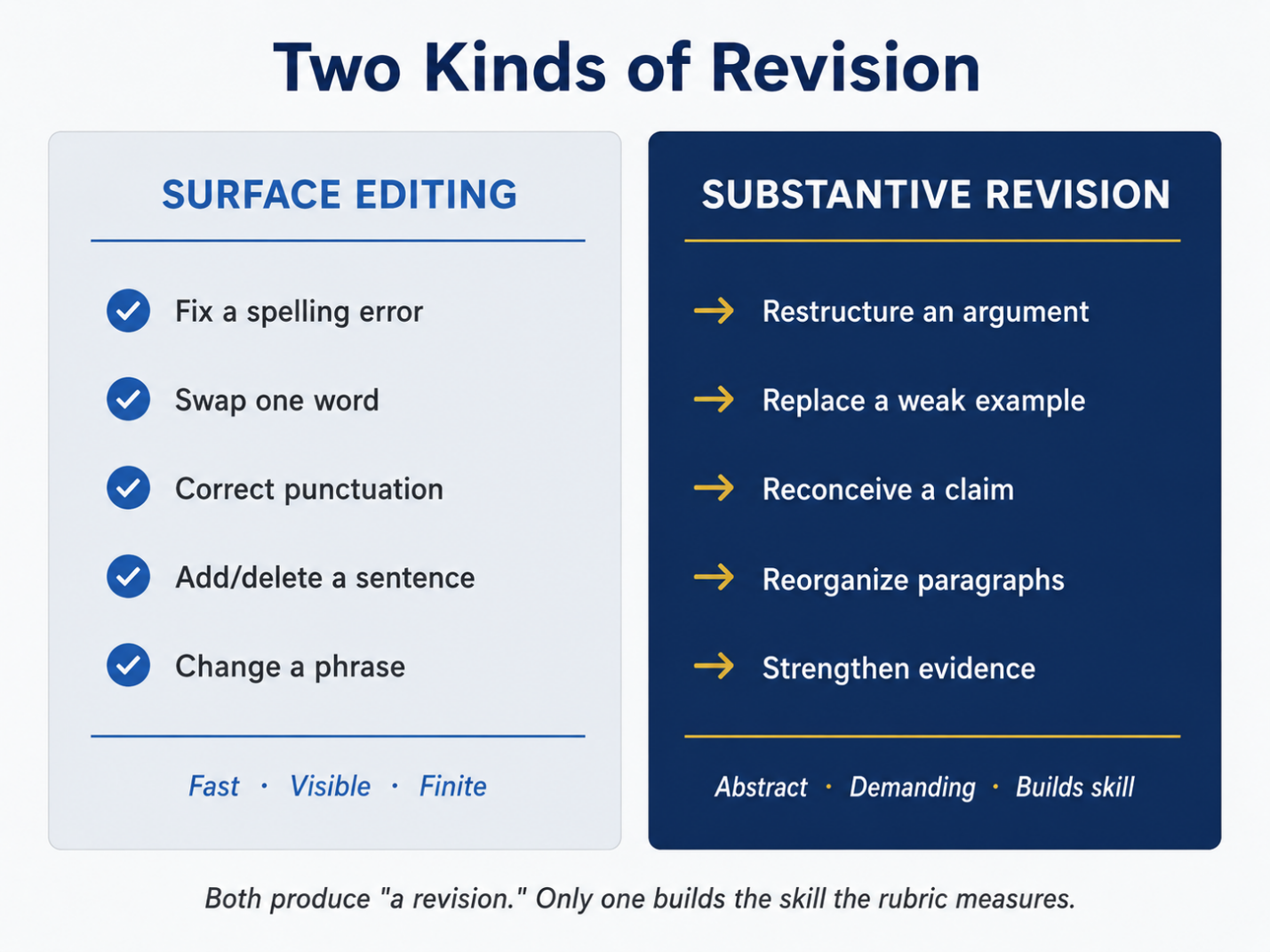
Substantive revision means reconsidering the writing from the inside out: strengthening an argument, reorganizing paragraphs, replacing a weak example with a more precise one, reconceiving a claim that does not actually say what the student meant to argue. It requires the student to hold two versions of the piece in mind simultaneously — the draft that exists and the argument the draft should make — identify the gap between them, and make a series of deliberate decisions about how to close it.
That is abstract, metacognitive work. Most middle school students are still building the capacity to do it reliably, which means they need structural support to do it at all. Without that support, they default to what is concrete, fast, and visible: surface corrections.
Surface editing — fixing spelling, correcting punctuation, swapping a synonym — produces a visible result without requiring the student to question what she wrote. Both surface editing and substantive revision produce “a revision.” Only one builds the skill the rubric is trying to measure. Students who cannot see the difference between them, or who have never seen the difference made explicit, will default to the faster, easier option every time.
Why Surface Edits Win Every Time
Three properties make surface editing the rational default for middle school writers, and they operate independently of student motivation.
Concrete tasks consistently outcompete abstract ones when students self-direct. A misspelled word is wrong in an objective, visible way. An underdeveloped argument is wrong in a way that requires interpretation, judgment, and re-entry into the thinking that produced the draft. When students are given open-ended revision time, they gravitate toward the task that has a clear completion state.
Surface editing is fast. A spelling correction takes under a minute. Substantive revision requires sustained engagement: re-reading with critical distance, identifying what is not working, and rewriting sections that were already considered finished. For a student who has never been shown what that process looks like, the cognitive demand of substantive revision is opaque in addition to being effortful.
Surface edits are invisible enough to pass. A teacher reading only a final draft cannot reliably tell whether it represents a first draft with minor corrections or a meaningfully revised version unless she has both. Students learn this quickly. When surface edits receive the same credit as substantive revision — which they do in any assignment structure that grades only the final product — surface edits become the rational choice. Not the lazy choice. The rational one.
The Developmental Window
Grades 6 through 8 represent the transition from narrative to analytical writing. In elementary school, students write primarily about personal experience. The cognitive demand is real, but the task is bounded: the student is the subject, the events occurred, the feelings were felt. Revision in this context tends to mean adding more detail or making the story clearer.
In middle school, the expectation shifts: analyze this text, argue this position, support this claim with evidence. The student is no longer the subject, and the claim the student makes could be wrong. Revision becomes consequential in a new way because the writing is now making arguments that could be strengthened, weakened, or reconceived — not just events that could be described more vividly.
Steve Graham and Dolores Perin’s 2007 meta-analysis Writing Next, conducted for the Alliance for Excellent Education, identified explicit instruction in revision strategies as one of eleven key elements of effective writing instruction for adolescents. The meta-analysis found it particularly underdeveloped at the middle school level, where assignment structures tend to prioritize completion over process. Students who receive no structured revision instruction during this window are significantly more likely to produce surface-level corrections throughout secondary school.
What Teachers Are Working Against
The structural conditions in most middle school writing classrooms favor surface editing even when teachers actively try to push against it.
Assignment volume and rubric design are the two biggest factors. A typical middle school ELA teacher manages four to five sections of 25 to 30 students each. Extended writing assignments create a feedback bottleneck: meaningful feedback on one round of drafts takes 10 to 15 minutes per student, which translates to 17 to 33 hours of work for one assignment cycle. The rational response to this constraint is fewer extended writing assignments, which means fewer opportunities to build the revision cycle at all.
Rubric design compounds the problem. When rubrics allocate most of their points to completion and final submission quality, without distinguishing between surface and substantive revision, students respond rationally: they do what the rubric rewards. Arthur Applebee and Judith Langer’s 2011 national study of writing instruction, published in English Journal, found that extended writing tasks requiring multiple revision cycles were rare in middle school classrooms, where short-answer and on-demand writing dominated the assignment mix.
The Compounding Effect
A student who surface-edits through sixth grade does not arrive in seventh grade with a blank slate. She arrives with a fully formed understanding of revision built from a year of confirmation that changing a few words is sufficient. By eighth grade, that understanding has had two full years to calcify. By ninth grade, the high school teacher who receives this student encounters not a learner who has not been introduced to revision, but one who has been introduced to a definition of revision that is difficult to dislodge.
The critical point of intervention is middle school, where the habit is still forming. The high school revision problem — well documented in the research on college readiness and argumentation — very often originates here, in the gap between what middle school writing instruction asks for and what substantive revision actually requires.
Practical Starting Points for Middle School Teachers
The problem is structural, so the interventions that move it are structural.
- Require documentation of changes. Ask students to submit a brief written log of what they changed between drafts and why they changed it. The explanation requirement forces conscious engagement with the revision decision rather than automatic word-swapping. A student who cannot explain her revision decision has not made a revision decision — she has made a correction.
- Make both drafts visible. Require students to submit the original draft alongside the revised version. A student who submits two nearly identical documents has not concealed anything. More importantly, the teacher can see the delta between drafts rather than evaluating only the endpoint. The draft comparison is where revision becomes teachable.
- Name the levels explicitly. Students cannot aim at a target they have never seen defined. Most students who surface-edit do not understand that what they are doing is different from what the assignment is asking for. A visible, explicit definition of the difference between surface editing and substantive revision gives students a framework to self-assess against before they resubmit.
- Reduce assignment volume and build revision depth. Fewer assignments with complete revision cycles are more valuable developmentally than more assignments with single drafts. Frequency of the full process, not frequency of initial drafts, builds the skill.
- Tie rubric points to revision depth, not just final quality. When the assessment structure distinguishes between surface and substantive changes, students have a concrete scoring incentive to engage more deeply. Without that distinction in the rubric, the grading signal and the instructional goal point in different directions.
The Through Line
Surface edits win in middle school classrooms not because students are avoiding work but because the system rarely makes substantive revision visible, required, or assessed as distinct from surface-level correction. The student who changes ten words and resubmits has followed the workflow exactly as it was designed. The problem is the design.
The revision habits students build in middle school are the revision habits they carry into high school. That is where the window is, and that is where most writing programs have not yet looked closely enough.
Sources referenced: Graham, S. & Perin, D., Writing Next (Alliance for Excellent Education, 2007); Applebee, A.N. & Langer, J.A., “A Snapshot of Writing Instruction in Middle Schools and High Schools,” English Journal (2011).