A middle school ELA teacher sits down for a draft conference with a student and notices something. The argument is structured correctly. The syntax is cleaner than anything the student has produced in class. The transitions are present. Something is off, but she cannot prove it, and a detection tool applied after the fact cannot settle the question. She moves on. This scenario is no longer unusual — and the problem it represents is not a technology problem. It is a visibility problem with a technology dimension.
Common Sense Media’s 2023 survey found that a majority of students ages 11 through 18 have used a general AI tool for a school assignment, with ChatGPT the most frequently cited. The tools are free, require no technical knowledge, and can produce a competent first draft in under three minutes. Whether a school has an AI policy has limited bearing on a student’s decision at 10 p.m. the night before the assignment is due.
What Teachers Are Actually Asking
The RAND Corporation’s 2023–2024 national survey of K–12 teachers found that the most common teacher concern about AI is not about prohibition. It is about visibility. Teachers want to know what students are actually doing during the writing process. The concern is not that AI tools exist. The concern is that student work no longer reliably reflects student thinking, and teachers have no reliable mechanism to know the difference.
This is a genuine instructional problem, not a compliance problem. Writing assignments exist because the cognitive work of constructing an argument develops something: analytical capacity, facility with evidence, the ability to revise toward a clearer claim. When a student outsources that work to a language model, the product can be acceptable while the development remains absent. A teacher who receives an AI-generated draft has received a document. She has not received evidence that her student knows how to write.
Why Detection Is the Wrong Tool
AI detection software proliferated quickly in response to teacher concern. The evidence for its reliability is weak, and in some cases the evidence runs the other direction. A 2023 Stanford Internet Observatory study found that AI detectors disproportionately flag writing by non-native English speakers as AI-generated. This produces adversarial dynamics without solving the underlying problem: a false positive accuses a student of something she did not do, while a false negative lets a student off the hook for something she did. The detection tool fails in both directions.
More fundamentally, detection misidentifies what the problem actually is. Whether a piece of writing was produced by a machine is not the issue. The issue is whether the student engaged in the cognitive work the assignment was designed to produce. No detection tool measures that. The only way to answer the question is to design instruction where the process is visible — where the teacher can see what the student did during writing, not just what the student submitted after.
Detection is also a reactive posture. It responds after the work has been submitted, after the learning opportunity has passed, and after whatever development the assignment was supposed to produce has not occurred. A sixth grader who outsources an essay to an AI tool on a Tuesday has not practiced writing. No detection tool on Friday changes that.
Why Middle School Is a Different Stakes Environment
The AI integrity problem exists across grade levels, but the stakes at the middle school level are distinct. A high school junior who bypasses a writing assignment with AI has avoided a task. A sixth grader who does so consistently may never develop foundational writing skills at all.
Grades 6 through 8 are where students transition from narrative to analytical writing: from describing personal experience to constructing arguments with evidence. Graham and Perin’s 2007 meta-analysis Writing Next identified this window as critical for the development of revision strategies, extended argument construction, and evidence-based reasoning. These are skills students need to build through practice, not skills they can acquire passively by reading feedback on work an AI produced.
The compounding effect over two to three years of middle school is significant. A student who consistently uses AI for writing assignments arrives in ninth grade with no working framework for argument construction, no practice with evidence evaluation, and no experience with meaningful revision. The high school teacher who receives that student does not have a student who did the work inefficiently. She has a student who has not done the work at all.
What Actually Addresses the Problem
The teachers who have most effectively addressed this problem have not found a better detection tool. They have changed what the workflow looks like.
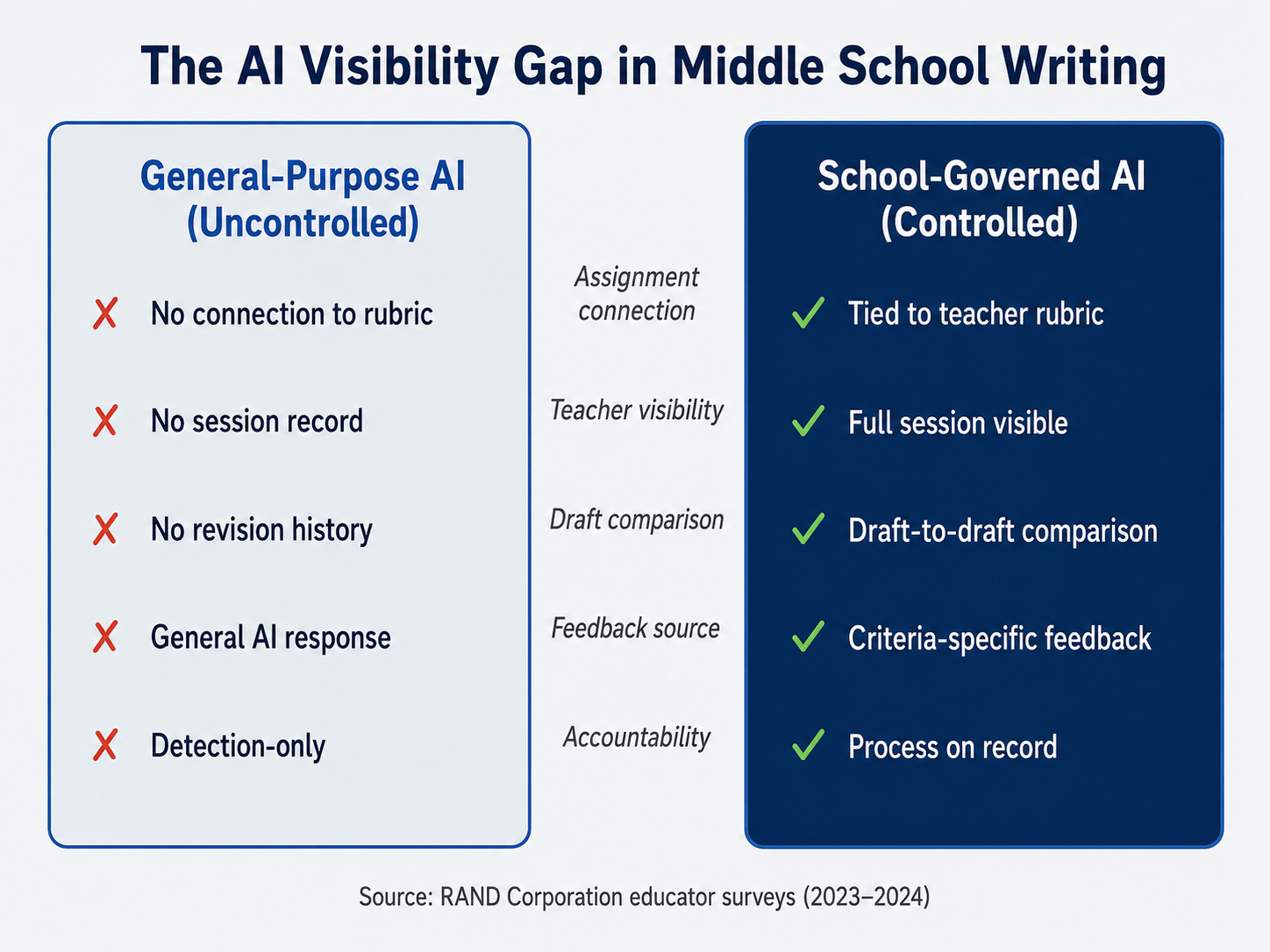
The key distinction is between student-initiated AI use and class-governed AI use. When students access general-purpose AI tools independently, outside the classroom, with no connection to the teacher’s assignment, the teacher sees only the product. The process is invisible. When students use AI tools inside a class-governed, assignment-bounded structure, the teacher can see the sequence of drafts, the feedback cycles, and how the work changed over time. Those are different instructional situations with different accountability structures.
An AI policy that prohibits student use of general-purpose tools but deploys no bounded, class-visible alternative has raised the standard without providing infrastructure to support it. The honest version of this policy is: we are asking students to decide, without accountability or support, to do the harder thing rather than the easier one. That is not an instructional design. That is an honor code.
Practical Starting Points for Teachers
- Build process into the assignment, not just the submission. A brief in-class draft session, a required conference, or a written explanation of revision decisions creates a process record that a product-only submission cannot provide. A student who has engaged with the writing in a visible way leaves a trail. A student who outsourced the work does not.
- Make the drafts visible. Requiring students to submit a first draft alongside the final version surfaces the student who submitted the same document twice. A teacher who sees only a final submission cannot identify this. The draft comparison is the simplest visibility mechanism available.
- Distinguish between AI assistance and AI substitution. A student who uses a class-linked tool to get feedback on an argument she constructed is using AI as a developmental resource. A student who uses a general-purpose tool to produce the argument is bypassing the developmental task entirely. Most AI policies do not draw this line, and that absence is where the problem lives.
- Ask students to explain the work. A brief student reflection — what did you change between drafts and why — requires a student to articulate the revision decision. A student who outsourced the work cannot produce a coherent explanation of revision decisions she did not make.
The Through Line
The AI problem in middle school writing is not a prohibition problem with a detection solution. It is a visibility problem that requires an instructional architecture response. The question that matters is not whether AI reaches middle school students. It does. The question is whether the AI students engage with in instructional contexts is visible to their teachers, bounded by the assignment, and connected to a learning process the teacher can assess and the student can benefit from.
The policy version of this problem asks: did they cheat? The instructional version asks: did they develop? Only one of those questions has a reliable answer, and it is not the detection-based one.
Sources referenced: Common Sense Media, AI and Teens (2023); RAND Corporation, “K–12 Teachers’ Experiences With Artificial Intelligence” (2023–2024); Graham, S. & Perin, D., Writing Next (Alliance for Excellent Education, 2007); Stanford Internet Observatory (2023).