A fourth-grade teacher marks up a set of essays with specific, carefully written comments. He returns the papers. The next assignment looks nearly identical to the previous one. He spends more time on feedback for the next round, writing longer comments with more explanation. The results are the same. At some point he concludes that his students do not read his comments, or do not care, or cannot act on them.
None of those conclusions is accurate. The explanation is developmental and structural. Upper elementary students are still building the metacognitive capacity to hold feedback in mind, locate where it applies in their own writing, and execute a specific change. That capacity is trainable, but it does not develop automatically in response to written comments returned after the work has been submitted and graded.
What Feedback Upper Elementary Students Can Act On
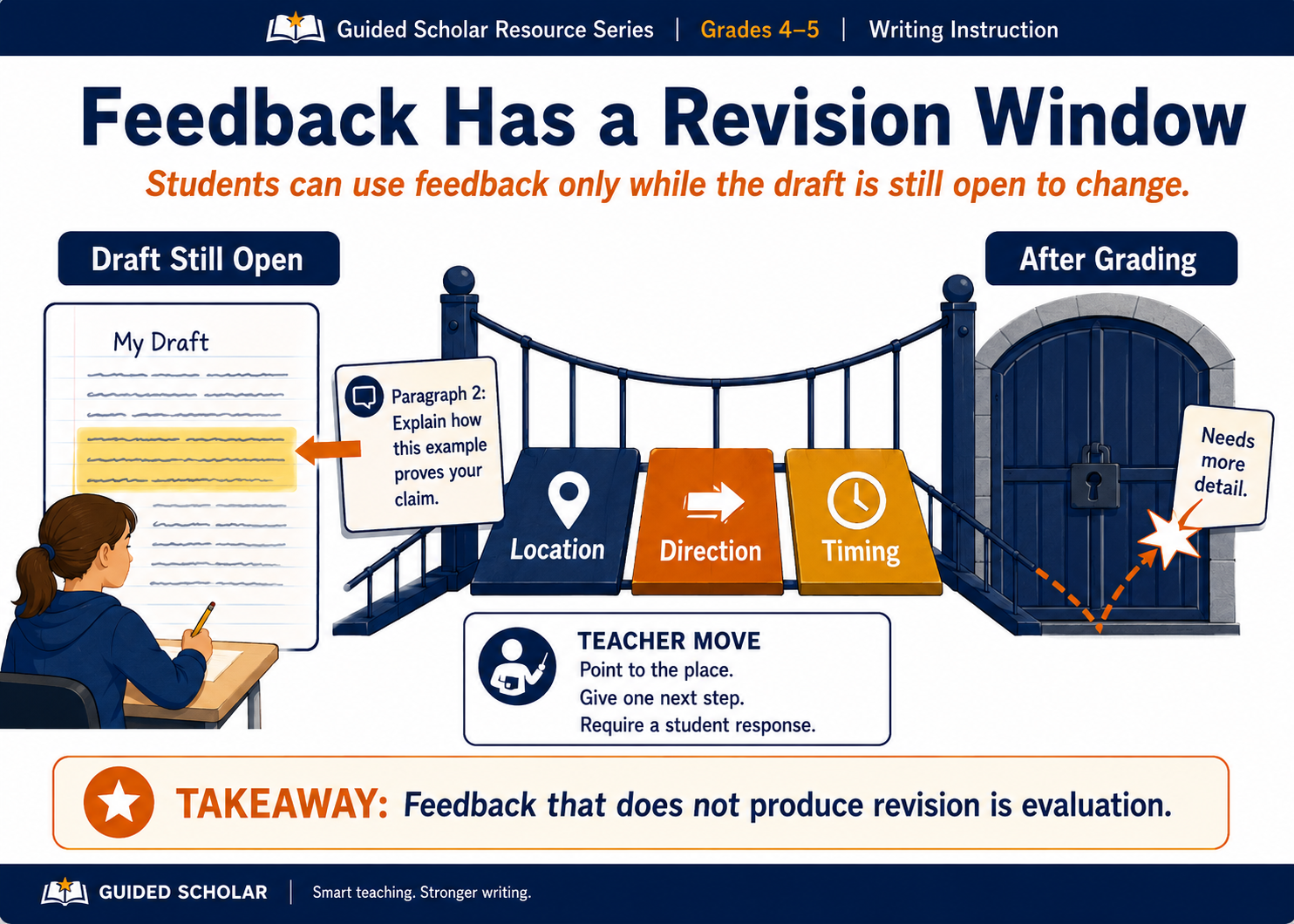
Not all feedback produces revision. At grades 4 and 5, feedback is most likely to produce meaningful change when it has three specific properties.
It must be tied to a location. “Your evidence is weak” gives the student no starting point. “In your second paragraph, the example you chose does not connect to your main point” tells the student exactly where to look. Without the location, students read the comment, understand it in the abstract, and have no idea which sentence or paragraph needs to change.
It must give a direction, not just a diagnosis. A comment that names the problem without indicating what to do about it leaves the revision work entirely to the student. For a fourth grader who could not produce the correct version in the first place, this is asking him to do on revision what he could not do on the draft. A comment that says “add a sentence explaining what this example proves about your claim” gives the student a specific task.
It must arrive while there is still something to change. Feedback returned after a final grade is evaluation, not instruction. Students who cannot revise against the feedback cannot apply it to the next assignment either, because the connection between the comment and the specific piece of writing no longer exists. Feedback delivered during the drafting or revision process, when the student can still act on it, is instruction.
The Timing Problem
Timing is the structural variable that most teachers have the least control over under standard assignment design. A teacher assigns a writing piece on Monday, collects drafts on Friday, and returns them the following week with comments. By the time the feedback arrives, the student has moved on. The comments land on a finished product with a grade attached.
Applebee and Langer’s 2011 research on writing instruction found that single-draft submission followed by terminal evaluation was the dominant pattern in elementary classrooms. Revision cycles were rare at the upper elementary level. A feedback system requires built-in time between first draft and final submission, which means fewer assignments of greater depth. The teachers who solve the timing problem do so by changing the assignment structure, not by writing faster.
The Specificity Problem
John Hattie’s synthesis of learning research in Visible Learning (2009) categorized feedback by level. Feedback at the self level (“great effort”) and the task completion level (“you finished the assignment”) produce no meaningful change in subsequent performance. The feedback that produces learning is at the process level: it tells the student what to do differently in the execution of the specific task.
Most written feedback on upper elementary writing falls below the process level. “Good ideas but needs more detail” is task-completion feedback. “Interesting perspective” is self-level feedback. Neither tells the student what to do differently. Process-level feedback requires the teacher to name the problem in the student’s specific draft, at the specific location where it occurs, with a specific direction for revision. A feedback template tied to the assignment rubric is worth building for exactly this reason: it allows a teacher to deliver targeted, consistent feedback without generating new language from scratch for every student.
The Volume Problem
A teacher with 25 students who spends five minutes per student on written feedback has invested two hours in one assignment cycle. This is manageable when feedback is limited to one or two specific criteria per assignment rather than comprehensive commentary on every dimension of the writing. The decision about what to prioritize is instructional, not logistical.
A teacher who identifies that a student’s main gap is evidence connection and gives one specific, directive comment on that gap, rather than five general comments distributed across the paper, is investing feedback time where it will produce the most learning. Focused feedback on the highest-priority gap outperforms diffuse feedback across all gaps, both for student development and for teacher time.
What This Looks Like in Guided Scholar
Guided Scholar’s Teach Me mode delivers paragraph-level feedback during the writing process, before a final draft exists. Each feedback cycle is tied to the teacher’s specific rubric and assignment criteria. The feedback names the location, identifies the gap, and gives a specific direction. A student can revise the section, receive another feedback cycle, and continue working through the feedback until satisfied before moving to the next paragraph. The teacher sees the full session: what the student submitted at each stage, what feedback was delivered, and how the draft changed in response.
For the upper elementary teacher, this architecture addresses the timing problem directly. Feedback arrives during the drafting process, not after submission. The revision window is open. A teacher who can see that a student engaged with specific feedback and produced a revised paragraph that addressed the identified gap has more useful instructional information than a stack of graded papers with comments that were never acted on.
Practical Starting Points for Teachers
- Name the location before naming the problem. Paragraph two, sentence three is the starting point. What is wrong there follows. Location-first feedback gives students an entry point they can act on.
- Limit feedback to one directive per cycle. Students who receive three separate feedback points often address zero of them. One specific, actionable direction per feedback cycle is more effective than a comprehensive list.
- Deliver feedback during drafting, not only after submission. A comment on a student’s first paragraph, returned the same day it was written, creates a revision window. A comment returned a week after submission does not.
- Build feedback templates for major assignment types. Standard language for each criterion reduces feedback generation time and ensures consistent, specific guidance. Consistency also helps students recognize patterns across assignments.
- Require a written response to every feedback comment. One sentence: what did you change and why? This closes the feedback loop and confirms whether the student understood the comment or simply made a surface correction and moved on.
The Through Line
Feedback that does not produce revision is evaluation. A teacher who invests significant time in written comments returned after a final grade has done evaluative work. The instructional work, feedback that changes what students do next, arrives during the process, not after it. The structural change is not more feedback. It is feedback delivered at the right moment, specific enough to tell students what to do, and followed by a requirement that they respond. Those three conditions change what feedback produces. Nothing else does.
Sources referenced: Hattie, J., Visible Learning (Routledge, 2009); Applebee, A.N. & Langer, J.A., “A Snapshot of Writing Instruction in Middle Schools and High Schools,” English Journal (2011); Graham, S. & Perin, D., Writing Next (Alliance for Excellent Education, 2007).