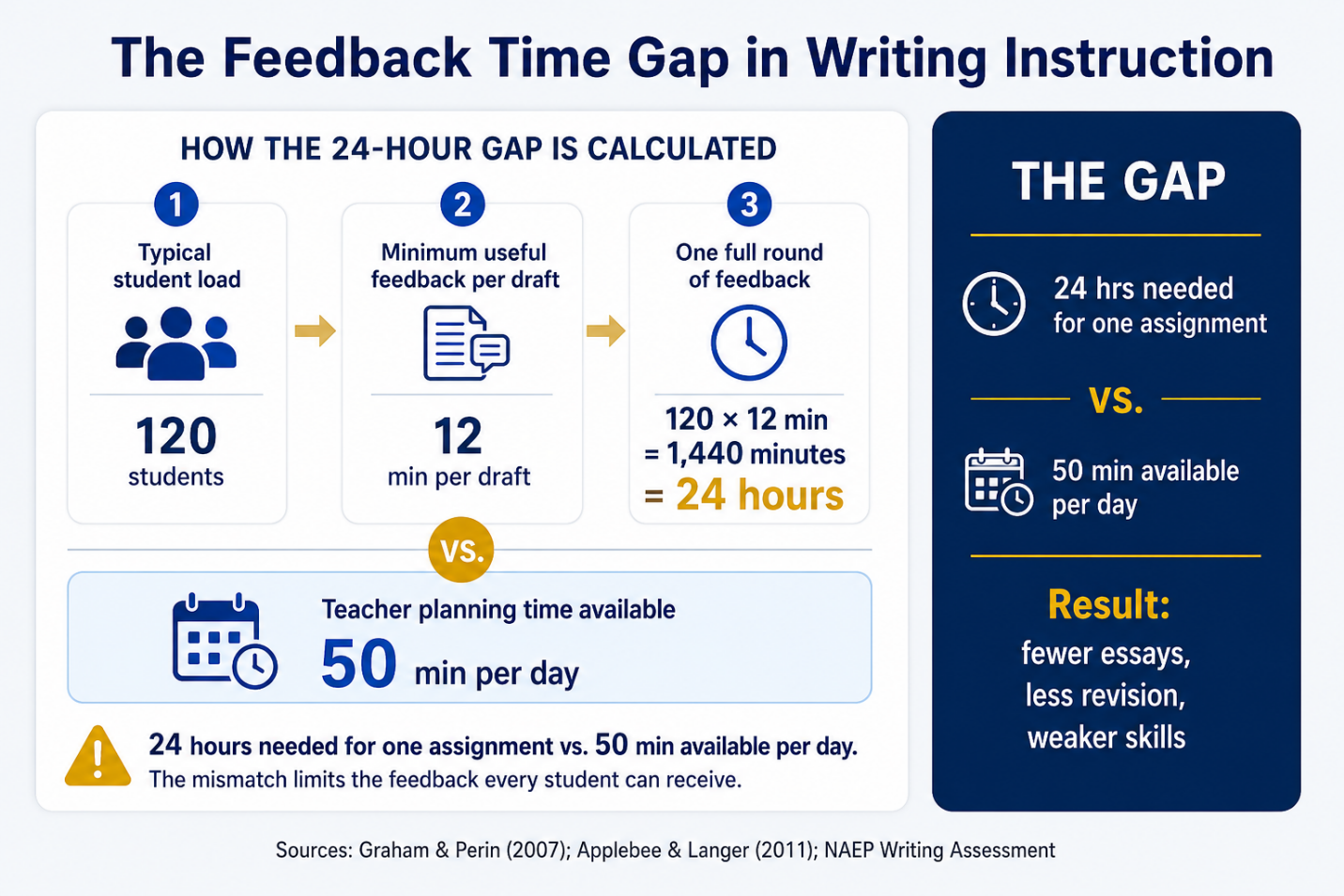
The most consequential writing assignment is often the one that never gets assigned. A middle school ELA teacher with 120 students is not making an arbitrary decision when she assigns a paragraph response instead of an extended essay. She is doing math. Meaningful feedback on one round of extended writing takes 10 to 15 minutes per student: 17 to 33 hours of work for one assignment cycle, for a teacher who receives one planning period per day.
A standard middle school ELA load runs four to five sections of 25 to 30 students each. That single assignment would consume more than two full weeks of planning time, exclusive of every other task the planning period is supposed to cover. This is not exceptional workload. This is what one extended writing assignment costs every time it is assigned. The constraint does not yield to effort or dedication. It is structural.
The Downstream Cost
Writing skill develops through a specific sequence: drafting, receiving feedback, and revising against that feedback. No stage can substitute for another. A student who writes frequently but without feedback reinforces existing habits rather than developing new ones. A student who receives feedback but writes infrequently does not build the fluency needed to act on that feedback effectively.
Graham and Perin’s 2007 meta-analysis Writing Next identified the frequency of extended writing practice as a foundational prerequisite to writing development, not a supplementary enrichment factor. Students who write extended pieces more frequently consistently outperform those who do not on assessments of argument quality, evidence integration, and revision depth. NAEP writing assessment data supports the same finding: students who report writing extended pieces more frequently — more than a paragraph, requiring sustained argument — outperform students who write primarily in short-answer format, regardless of other instructional factors.
The practical implication is uncomfortable. When teachers reduce extended writing frequency to manage the feedback load, they reduce the most consequential instructional activity for writing development. The decision makes sense given the constraints. The consequence for students is significant regardless.
What Middle School Specifically Loses
Applebee and Langer’s 2011 national study of writing instruction in secondary schools found that extended writing — defined as writing of more than a paragraph, requiring reasoning and development — occupied a surprisingly small share of instructional time in most middle school classrooms. Short-answer responses, sentence completions, and on-demand writes dominated the assignment mix. Extended argumentative writing was rare, and in some classrooms was assigned only once or twice per term.
The developmental cost of this pattern concentrates at the middle school level for a specific reason. Grades 6 through 8 are where students transition from narrative to analytical writing. This is where students are expected to construct arguments, evaluate evidence, and revise drafts against criteria rather than against a feeling that something is done. If students do not practice these skills with adequate frequency during this developmental window, they arrive in ninth grade without the foundational framework the high school curriculum assumes they have.
A sixth grader who spends a year primarily writing paragraph responses has not practiced sustained argument construction once. That is not a skill gap. It is the absence of foundational experience. The high school teacher who receives that student three years later is working with someone who needs to build the foundation in a curriculum that assumed the foundation already existed.
The Compounding Effect
The bottleneck compounds in two directions. Teachers who reduce extended writing frequency to manage feedback load produce students with less extended writing experience. Those students arrive in each subsequent grade less prepared to benefit from the extended writing assignments they encounter. The high school teacher who responds by reducing complexity produces students who arrive at college without the skills college writing requires.
This is the throughline that runs from the middle school feedback constraint to the college readiness gap. It is not a question of teacher quality or student ability. It is the structural consequence of an instructional resource — teacher feedback time — that cannot scale to meet what evidence-based writing instruction requires.
What Changes the Math
The feedback bottleneck is not a time management problem and is not solved by telling teachers to write shorter comments. It is solved by changing the feedback infrastructure — specifically, by changing where teacher time goes in the feedback cycle.
The most effective structural shifts share a common pattern: they reduce the time teachers spend generating feedback from scratch on every draft, and increase the time teachers spend responding to whether students engaged with feedback they have already received. Criteria-referenced feedback templates give students specific, rubric-aligned direction and reduce feedback composition time without reducing specificity. Peer review structured around clear criteria shifts some feedback delivery to students, freeing teacher time for the revision response rather than the initial diagnosis. Class-visibility tools that show teachers at a glance which students have engaged with feedback and which have not allow teachers to direct detailed attention where it is most needed rather than distributing effort evenly across the class.
None of these changes ask teachers to work faster. They change what the work is. The goal is not to make feedback generation more efficient. It is to redesign the workflow so that teacher time is concentrated at the instructional moment where it has the most leverage: responding to whether students did something meaningful with the feedback they received.
Practical Starting Points for Teachers
- Build one full revision cycle into the term before building more. A single assignment with a real first draft, criteria-specific feedback, and a required revision cycle is worth more developmentally than multiple assignments with no revision cycle at all. Start with one and design it deliberately.
- Create a feedback template for each major assignment criterion. The template frames the feedback in terms of the criterion and gives the student a specific revision direction. Feedback delivery time drops significantly; specificity does not. A teacher who re-creates feedback language from scratch for 120 students is doing work the template can do.
- Use peer review as the first feedback pass. Students who have engaged with peer feedback before the teacher reads the draft have already begun the revision process. Teacher time goes to assessing the response to feedback rather than generating the first feedback from scratch. The teacher’s attention is more valuable at the revision response stage than at the initial diagnosis stage.
- Collect first drafts. The comparison between a first draft and a final draft shows whether revision happened, makes the teacher’s feedback visible, and surfaces whether it was acted on. A teacher who sees only a final submission has no way to assess the revision process. A teacher who sees both drafts has the only evidence that matters.
The Through Line
The feedback bottleneck is structural, and the solution is structural. The frequency of extended writing that students need and the feedback capacity of a single teacher with 120 students are genuinely incompatible under a standard workflow. Schools that have increased middle school writing volume without increasing teacher workload have changed the design of the feedback system, not the dedication of the teachers.
The path forward is not finding time that does not exist. It is redesigning the workflow so that the writing volume students need is something the system can actually support.
Sources referenced: Graham, S. & Perin, D., Writing Next (Alliance for Excellent Education, 2007); Applebee, A.N. & Langer, J.A., “A Snapshot of Writing Instruction in Middle Schools and High Schools,” English Journal (2011); NAEP Writing Assessment data, National Center for Education Statistics.