A teacher assigns a ten-minute presentation on renewable energy. Every student produces slides. Every slide has a heading and three to five bullets. The students know their material. They cannot figure out how to put it on a slide any other way, because bullet points are the only format most of them have ever used. The first step toward better student presentations is not better design software. It is understanding when bullets help and when they actively work against the communication.
When Bullets Actually Work
Bullets serve a real purpose when items are genuinely parallel, discrete, and independent. A slide listing the five required documents for a passport application works in bullet format. A slide listing the four branches of the federal government works in bullet format. The items carry equal weight, the reader’s understanding of each does not depend on understanding how they connect, and the order could be rearranged without changing the meaning.
The test is whether the items are truly equivalent and independent. If they are, bullets are appropriate. If the items form a sequence, if understanding one requires understanding the previous, or if the argument depends on the relationship between them, bullets destroy the argument by removing the connections.
What Bullets Do to an Argument
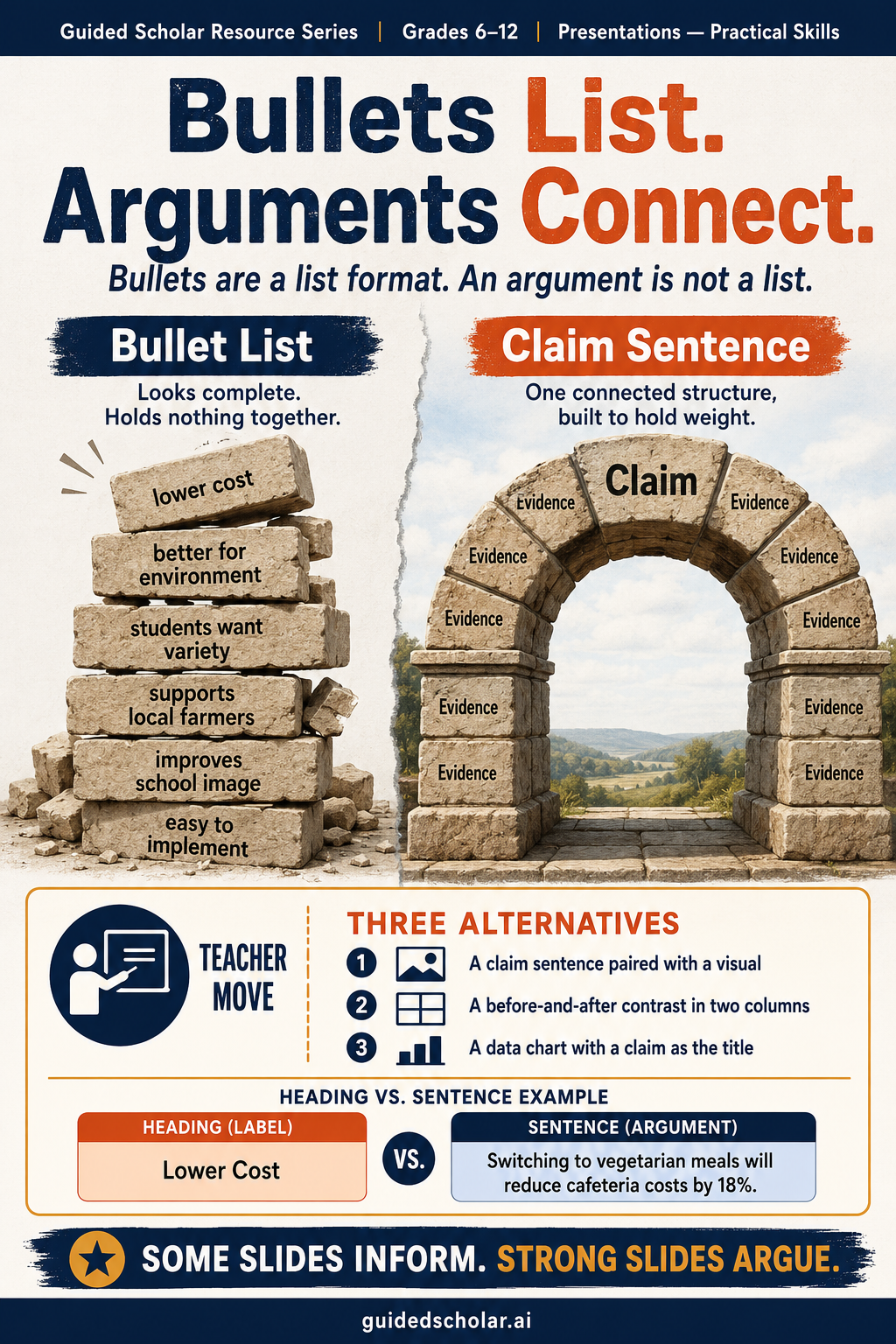
An argument depends on logic: this evidence establishes this fact, which supports this claim, which is why this conclusion follows. When that reasoning is broken into bullets, the logical chain disappears and the items appear as parallel and equivalent rather than sequential and connected.
Consider a student arguing that the school cafeteria should offer more vegetarian options. A bullet slide might read:
Bullet version: Benefits of Vegetarian Options • Lower cost per meal • Better for the environment • Students want more variety • Healthier for students
These four items are plausible and accurate. None of them connects to a specific argument. A skeptical reader sees a list of claims, not a case for a position. Now the same content as a sentence:
Sentence version: Vegetarian options cost 15–20% less per serving than meat-based meals, which means the cafeteria could reduce per-student lunch costs without reducing the menu — a budget argument, not a values one.
The sentence version makes one specific claim, states the evidence, and explains what the evidence establishes. It cannot be expressed in bullets without losing the reasoning. That reasoning is the argument.
Three Alternatives That Work Better Than Bullets
A single sentence claim displayed large, paired with a visual that supports it. The sentence does the argumentative work. The visual provides evidence. The speaker explains the connection between them. This structure works for any claim that has supporting data, a relevant photograph, or a diagram that shows the relationship being argued.
A before-and-after or contrast structure, displayed as two columns or two images side by side. The comparison is inherently argumentative: here is the problem, here is the solution. Here is the old approach, here is the better one. This structure requires no bullets and communicates the argument visually.
A data chart with a claim as the title. “Vegetarian Meals Cost 18% Less” as a chart title turns a bar chart into an argument. “Cafeteria Cost Comparison” as the same chart’s title turns it into a reference document. The difference is one sentence that states what the data establishes rather than merely describing what the data shows.
The Heading-vs.-Sentence Distinction
The single most effective change a teacher can require is that every body slide carry a complete sentence rather than a heading label. A slide titled “Benefits of Vegetarian Options” tells the audience there are benefits. A slide that opens with “Vegetarian meals reduce cafeteria costs without reducing nutritional quality” tells the audience what to think about the topic. The sentence version is always more persuasive because it makes a claim the audience can engage with rather than announcing a category of information they are about to receive.
Students resist this change because they have been using heading labels since elementary school. A one-day lesson comparing a heading-plus-bullets slide to a sentence-plus-visual slide on identical content can do more to change student habits than a semester of rubric-based feedback that never shows them what the alternative looks like.
When Bullets Are the Right Tool
This is not an argument against bullets in all circumstances. Bullets are the right tool for checklists, ingredient lists, step-by-step instructions where each step is independent, and any content where the items are genuinely parallel and equivalent. A slide listing the documents required for an application, the ingredients in a compound, or the safety steps in a procedure is correctly formatted with bullets.
The problem is not bullets. The problem is using bullets as the default format for content that is not a list. Students who understand when bullets apply and when they harm have a conscious tool. Students who use bullets for everything have a reflex.
What This Looks Like in Guided Scholar
Guided Scholar’s Teach Me mode for presentation assignments asks students to state the claim of each section in one sentence before building slide content. When a section outline consists of bullets with no connecting argument, the feedback asks: what is the one thing this section establishes? The revision from bullet list to claim sentence happens at the outline stage, before any slide design decisions are made. A student who can state the section’s claim in one sentence is ready to build the slide. A student who cannot is not.
The Through Line
Bullet points are a formatting choice, not a law of slide design. Students who understand when bullets serve the communication and when they undermine it have a tool they can apply consciously. The teacher who shows students a concrete example of the difference gives them a target. Most students who have never seen a non-bullet body slide do not know that anything else is possible.
Sources referenced: Mayer, R., Multimedia Learning (Cambridge University Press, 2001); Atkinson, C., Beyond Bullet Points (Microsoft Press, 2007); Reynolds, G., Presentation Zen (New Riders, 2008).