Every school administrator fielding questions about AI in the classroom is navigating the same gap: the tools available to students are not the tools the school chose to deploy. A student with a phone or a Chromebook and a general-purpose AI account can produce an essay in three minutes. Whether the school has an AI policy or not is largely irrelevant to that student’s decision.
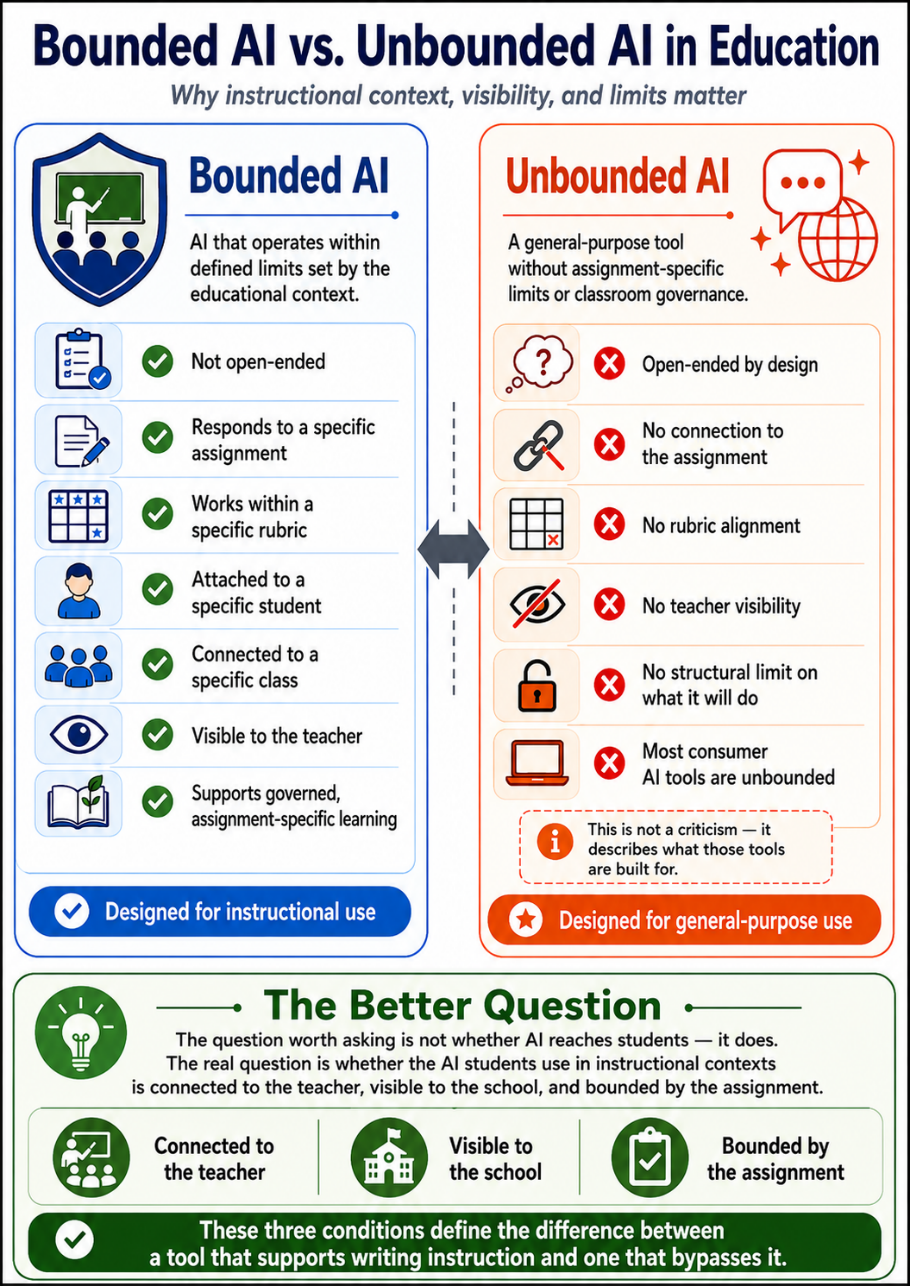
The question worth asking is not whether AI reaches students (it does), but whether the AI students use in instructional contexts is connected to the teacher, visible to the school, and bounded by the assignment. Those three conditions define the difference between a tool that supports writing instruction and one that bypasses it.
What “Bounded” Means
Bounded AI is AI that operates within defined limits set by the educational context. It is not open-ended. It is not a general-purpose assistant. It responds to a specific assignment, within a specific rubric, with a specific student attached to a specific class, and a teacher can see it.
Unbounded AI is the opposite: a general-purpose tool with no connection to the assignment, no visibility to the teacher, and no structural limit on what it will do for the student. Most consumer AI tools are unbounded by design. That is not a criticism. It is a description of what those tools are for. The problem arises when unbounded tools enter instructional contexts that require governed, visible, assignment-specific support.
Instructional AI that is unbounded produces the same outcome as no instructional AI at all: students get work done; teachers cannot tell who learned anything.
The Governance Problem with General AI Tools
The concern most administrators and teachers have about AI is usually framed as an integrity concern: did the student write this? General AI tools make that question difficult to answer, not because detection technology is insufficient, but because the question becomes structurally hard to resolve once the tool is general-purpose and private.
A student who uses a general AI tool to produce a draft has submitted something that reflects the AI’s writing process, not theirs. A teacher who cannot tell the difference between a student’s genuine writing and AI-generated output cannot assess the student’s development, identify where instruction is needed, or build a record of what the student can actually do.
That is not primarily an academic integrity problem. It is an instructional visibility problem. A teacher who cannot see what the student actually produced cannot teach that student.
What School-Governed AI Looks Like
The alternative to uncontrolled AI use is not no AI. It is AI that is governed at the school level: class-linked, assignment-bounded, and teacher-visible.
In a school-governed deployment, independent student practice is not private AI use. It is a governed, class-linked practice activity visible to the responsible teacher and controlled by the school deployment context. The student works within the system the school assigned, against a defined rubric, on the assignment the teacher designed. The teacher can see what the student submitted, what feedback was delivered, and whether the student revised.
That is a fundamentally different relationship between AI and instruction than what exists when a student opens a general-purpose tool and prompts it to write an essay.
What This Looks Like in Guided Scholar
Guided Scholar is built on the school-governed model. Students access it through a class-linked account, working within assignments the teacher configured. The AI uses the defined rubric while supporting the teachers directions, not as a general writing assistant, but as a structured feedback system tied to the specific criteria of the specific assignment.
The teacher dashboard makes every submission visible: original draft, feedback delivered, revision submitted, and revision depth compared between drafts. The teacher can see what the student did, whether the feedback connected, and where direct instruction is still needed.
Guided Scholar is not an autonomous grader. The system delivers rubric-aligned feedback and makes revision visible. The teacher evaluates the student’s response to that feedback and decides what happens next. That distinction between a tool that informs teacher judgment and one that replaces it is the commitment behind the product’s architecture: school-governed, teacher-connected, revision-oriented, assignment-bounded.
What to Verify Before Deploying Any AI Writing Tool
Before deploying any AI tool for student writing, four questions determine whether it supports instruction or circumvents it:
- Is student work visible to the teacher, or is the AI interaction private?
- Is the tool assignment-bounded, or can students use it for anything they want?
- Is feedback tied to specific rubric criteria, or general and interchangeable across any assignment?
- Does the system produce a revision record, or just a final output?
A tool that answers yes to all four is a school-governed instructional tool. A tool that answers no to any of them is, in practice, a general-purpose consumer tool with a school license.
The Through Line
The AI conversation in education is often framed as a binary: use AI or do not. That is not the actual choice available. The actual choice is between AI that is governed and visible and AI that is not. Students are already using AI. The question is whether the AI they use in instructional contexts is connected to the teacher, bounded by the assignment, and visible to the school, or whether it is operating without any of those conditions.
Bounded AI is not the absence of AI. It is AI that works within the structure of the classroom rather than around it. That distinction is what separates a tool that improves writing instruction from one that makes it harder to see what students are actually learning.