College writing instructors have a consistent observation about first-year students: they can produce a five-paragraph essay with a thesis, three supporting points, and a conclusion. What they cannot do is construct an argument. The difference is not a matter of polish or vocabulary. It is a structural gap in what high school writing has asked students to practice.
High school writing instruction has improved significantly in its focus on organization and mechanics. What it has not kept pace with is the kind of writing college actually demands: analyzing competing positions, evaluating evidence quality, building a line of reasoning that responds to counterarguments, and producing a claim that requires defense rather than illustration.
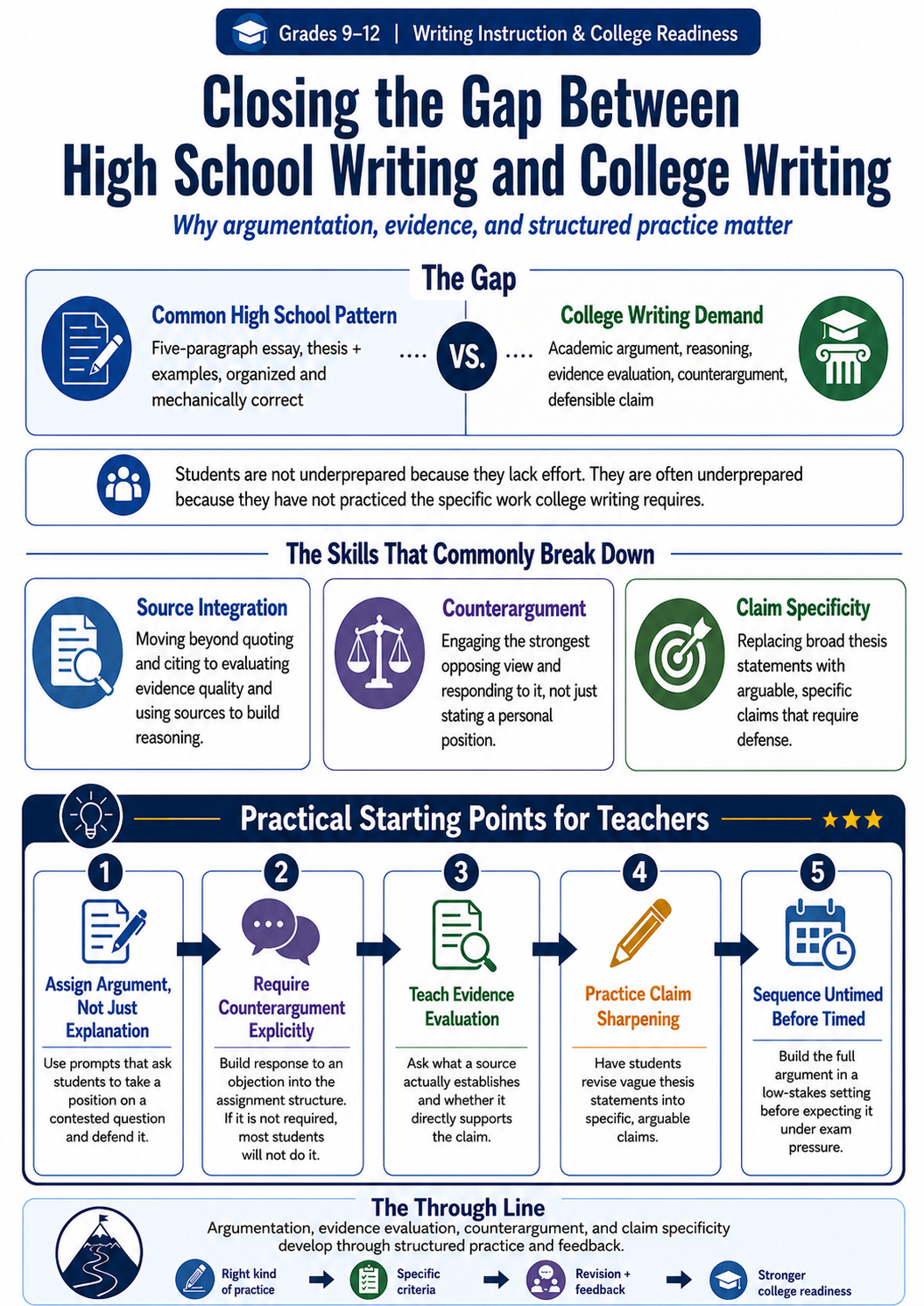
Students who arrive at college without those skills are not underprepared in the sense of lacking effort or intelligence. They are underprepared in the sense of never having been asked to do the specific work college writing requires.
What College Writing Actually Demands
First-year college writing courses, whether composition, rhetoric, or writing-intensive seminars, are built around a set of practices that most high school students have not encountered in a sustained way.
College writers are expected to read sources critically, not just summarize them. They are expected to evaluate the quality of evidence: whether it supports the claim, whether it is representative, whether it addresses the actual question. They are expected to construct arguments that anticipate objections and respond to them, not arguments that assert a position and list supporting examples.
That last distinction is where most incoming students encounter the wall. A five-paragraph essay asserts a thesis and illustrates it with three examples. An academic argument develops a claim through reasoning, acknowledges the strongest objection, and explains why the argument holds despite that objection. Those are different cognitive tasks. Students who have practiced one have not necessarily developed the other.
The Specific Skills That Break Down at the College Level
Three specific skills account for most of the gap between high school writing competency and college writing readiness.
- Source Integration. High school students are typically taught to cite sources and quote them. College writing requires evaluating sources: distinguishing strong evidence from weak, identifying what a source actually establishes versus what a student wants it to establish, and using sources to develop an argument rather than to support a predetermined conclusion.
- Counterargument. Most high school writing assignments do not require students to engage seriously with opposing positions. The assignment asks for the student’s perspective; the student provides it with supporting evidence. College writing almost always requires engaging with the strongest version of the opposing view. Students who have never practiced this cannot produce it under the time pressure of a college assignment.
- Claim Specificity. High school thesis statements are typically general: “Social media has both positive and negative effects on teenagers.” College claims are specific and arguable: a claim that requires a reader to push back, ask for evidence, or disagree with a substantive position. Students taught to write general thesis statements have not been taught to write arguable ones.
What the Research Says
Gerald Graff and Cathy Birkenstein’s “They Say / I Say” framework identified that the most common deficit in student writing is not weak evidence but the failure to position a claim in relation to other claims, entering a conversation rather than simply making a statement. The framework has been adopted widely at the high school level precisely because the gap appears before college, not at college.
Research by Arthur Applebee and Judith Langer, whose National Study of Writing Instruction surveyed secondary and post-secondary writing practices, found that extended writing (writing of more than a paragraph that requires reasoning and development) occupies a surprisingly small percentage of instructional time in most secondary classrooms. Students write frequently in fragments: answers, short responses, annotations. They write extended arguments rarely.
That finding has a direct practical implication. Students who arrive at college without experience writing extended arguments are not showing the effects of poor instruction. They are showing the effects of low frequency. More of the same kind of writing students are already doing does not close the gap. More writing that specifically requires argumentation, evidence evaluation, and counterargument does.
Practical Starting Points for Teachers
- Assign argument, not just explanation. A prompt that asks students to take a position on a contested question and defend it against an objection produces different writing than a prompt that asks them to describe, summarize, or explain.
- Require counterargument explicitly. Build the counterargument paragraph into the assignment structure. Students who are not required to address an objection will not do so.
- Teach evidence evaluation, not just citation. Ask students to explain what a source actually establishes and whether it directly supports the claim being made. Citation mechanics do not develop critical thinking about evidence.
- Practice claim sharpening. Give students their own vague thesis statements and ask them to rewrite them as arguable, specific claims. The revision process surfaces the difference between assertion and argument.
- Sequence untimed before timed. Students who have never constructed a full argument in a low-stakes context cannot produce one under exam conditions. Build the skill first, then test it under time pressure.
The Through Line
The gap between high school writing competency and college writing readiness is real, measurable, and not primarily the result of inadequate effort on either side. High school teachers teach what the assignment structure asks for. Students produce what they have been asked to practice.
The skills college writing demands, specifically argumentation, evidence evaluation, counterargument, and claim specificity, develop through practice with structured feedback. They do not develop through more of the same kind of writing students are already doing. The teachers who close this gap assign the right kind of writing, require revision against specific criteria, and give students the feedback to know the difference between what they produced and what the assignment actually asked for.
That is not a curriculum change. It is a practice change.
Sources referenced: Gerald Graff and Cathy Birkenstein, They Say / I Say (W.W. Norton, 2006); Arthur Applebee and Judith Langer, “What Is Happening in the Teaching of Writing?”, English Education (2009).