A teacher assigns ten timed ACT practice essays over a semester. He collects them, scores them, and returns composite scores. By the end of the semester, most students have improved their writing speed. Their ACT Writing scores have not moved. This pattern is familiar to any teacher who has run test preparation relying primarily on timed practice volume.
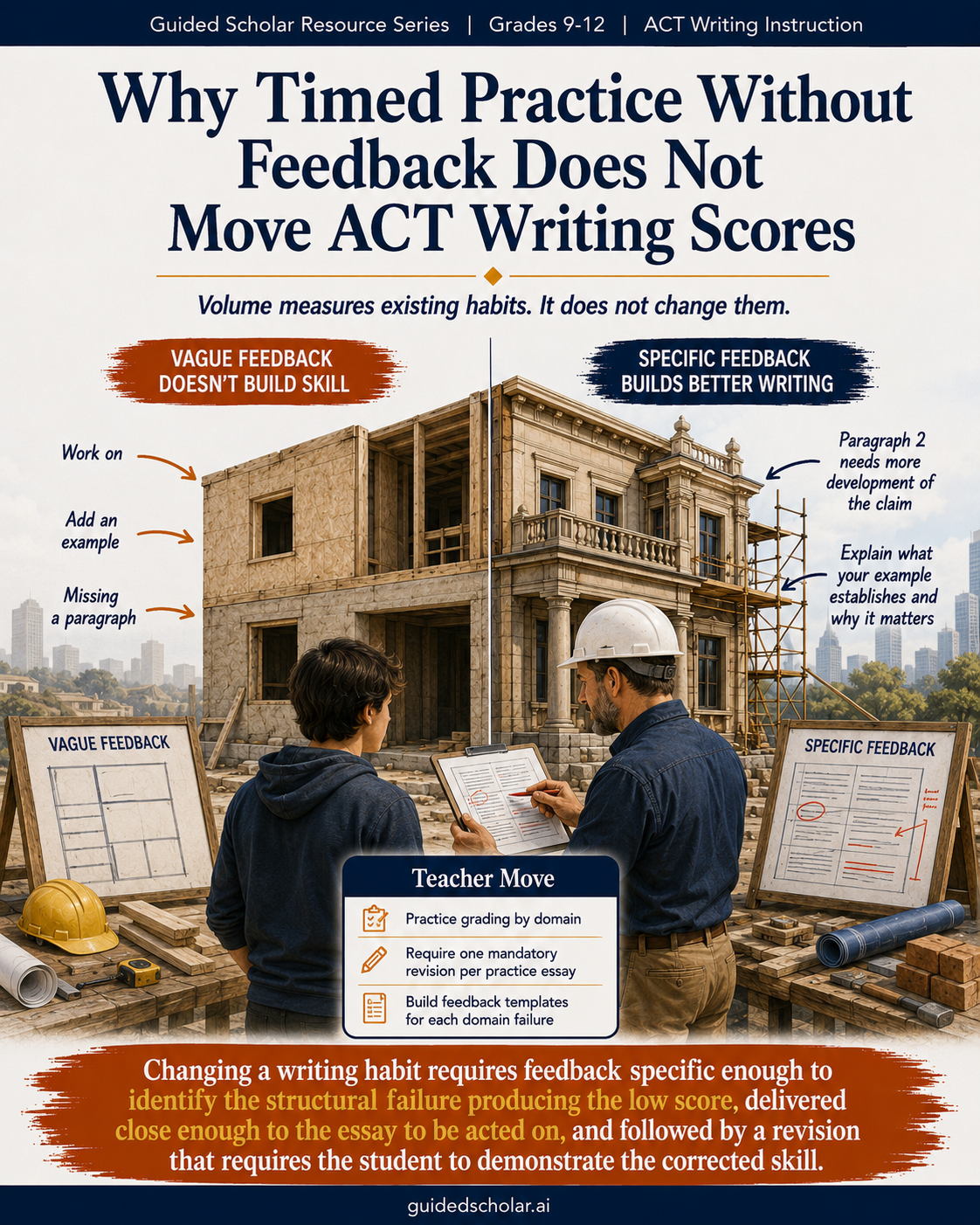
The problem is not the practice. It is what the practice is missing. Timed practice measures existing habits under time pressure. It does not change those habits. Changing a writing habit requires feedback specific enough to identify the structural failure producing the low score, delivered close enough to the essay to be acted on, and followed by a revision that requires the student to demonstrate the corrected skill. Without all three elements, more practice essays produce faster versions of the same structural failures.
What Practice Without Feedback Produces
A student who summarizes the ACT perspectives rather than engaging them will do so on every practice essay until someone specifically identifies that failure and gives her a direction. A student whose claim is a general position rather than a specific, arguable one will continue writing position-level theses until she understands the distinction and has practiced producing the alternative. A student whose body paragraphs illustrate rather than develop will keep illustrating.
Speed and volume increase with repetition. The underlying structural failures remain, because the student has never received information that identified them as structural failures rather than areas to “work on.” John Hattie’s synthesis of learning research in Visible Learning (2009) found that feedback is the single most powerful influence on student learning, but only when it is specific enough to tell the student what to do differently. Feedback that delivers a score says: this is how well you performed. Feedback that says “your paragraph in body paragraph two illustrates rather than develops your claim, explain what your example establishes and why it matters” says: this is what to do differently. Those are different things, and they produce different results.
The Domain Breakdown Requirement
The first structural change that moves ACT Writing scores is scoring practice essays by domain, not just by composite. A student whose final composite score is 8 knows how she did overall. A student whose domain breakdown shows Ideas and Analysis at 4, Development at 3, Organization at 5, and Language Use at 4 knows exactly where her score comes from and exactly where preparation time should focus.
Domain-level scoring takes more time per essay than composite scoring. The practical solution is a scoring template. A template that rates each domain with a brief specific note reduces per-essay scoring time significantly without reducing the informational value of the score. “Development: 4, illustration not development, paragraph 2 needs the missing explanation” is a domain score and a revision direction in ten words. Students can act on ten words.
The Revision Cycle Requirement
Domain-level feedback is necessary but not sufficient. The feedback loop that changes ACT writing habits has three steps: timed practice, specific domain feedback, and revision against that feedback. The revision step is what most ACT preparation programs skip. Students receive feedback, read it, and write the next essay. The feedback never produces a revision, so it never produces a demonstration that the student understood it or could apply it.
A student who revises her ACT essay after receiving specific domain feedback is doing something the composite-score model never asks her to do: she is identifying the structural failure, understanding what a corrected version requires, and producing it. That is the skill the ACT Writing section measures. The preparation that develops the skill is the preparation that requires its execution. Applebee and Langer’s research on writing instruction across grade levels identified revision directed by specific criteria as the instructional variable most consistently associated with writing improvement. ACT preparation is not exempt from this finding.
Sequencing Untimed Work Before Timed Practice
A structural failure students cannot address in untimed conditions is a structural failure they cannot address in forty minutes. Students who have never practiced constructing a specific, arguable claim in a low-pressure setting cannot produce one under time pressure. Students who have never written a paragraph that develops a claim through reasoning cannot do so in forty minutes on demand.
The preparation sequence that works is untimed skill development followed by timed application. Build the skill first: practice claim construction separately, practice perspective engagement separately, practice development separately. Then practice integrating those skills under time pressure. The timed practice becomes a test of skills students have actually built, rather than a repeated exposure to the same performance gap.
What This Looks Like in Guided Scholar
Guided Scholar’s ACT mode is built around the feedback-revision cycle. A student submits an essay and receives domain-level feedback aligned to the ACT rubric: specific identification of the structural failure in each domain and a directed revision prompt. The feedback names the problem, identifies where it occurs, and asks the student to revise before the session closes. The revision is required, not optional.
The teacher sees the original essay, the domain feedback received, and the revised version side by side. A teacher who can see that a student engaged with specific development feedback and produced a revised essay that explains the reasoning rather than dropping an example has more useful information about writing skill than a semester’s worth of composite practice scores. The revision is the evidence of learning.
Practical Starting Points for Teachers
- Score practice essays by domain before returning composite scores. The domain breakdown tells students where to focus. The composite tells them how they did. Both are useful. Only the domain breakdown drives focused preparation.
- Require one revision per practice essay before the next essay is assigned. A student who revises the previous essay based on domain feedback before writing the next one is practicing the actual skill. A student who reads the feedback and starts the next essay is practicing volume.
- Build feedback templates for each domain failure. Standard language for each ACT writing domain failure reduces the time teachers spend generating feedback and increases specificity. Naming the failure and giving a revision direction in a sentence does more than a paragraph of general commentary.
- Sequence untimed argument work before timed practice. Practice claim construction, perspective engagement, and paragraph development in untimed conditions before students are asked to integrate all three under time pressure. Build the skill before testing it.
The Through Line
Timed practice without feedback is measurement, not preparation. The ACT Writing score is not a measure of how many essays a student has written. It is a measure of how well a student can construct and develop a specific argument under time pressure. That skill develops through feedback-anchored revision cycles, not through the accumulation of practice essays scored by composite. The preparation that changes scores changes what students do when they write. That only happens when feedback is specific, timely, and followed by a requirement to revise against it.
Hattie, J., Visible Learning (Routledge, 2009); ACT Inc., ACT Writing Test Rubric (2016); Applebee, A.N. & Langer, J.A., The State of Writing Instruction in America's Schools (Center on English Learning & Achievement, 2006).