An ACT preparation teacher returns a set of practice essays. Several students are disappointed. Their essays are organized, the thesis is clear, and the writing is fluent, but composite scores have not moved. When she looks at the domain breakdown, she sees the same pattern across papers: Development and Support is consistently lower than Organization and Language Use. The essays are well-structured and well-written. They are not well-developed.
This is the development gap: the difference between essays that illustrate a claim and essays that develop one. The distinction is explicit in the rubric, but easy to overlook in student writing because illustration and development produce essays that look nearly identical from the outside. One has reasoning. The other has the appearance of reasoning without its substance.
What the Distinction Actually Means
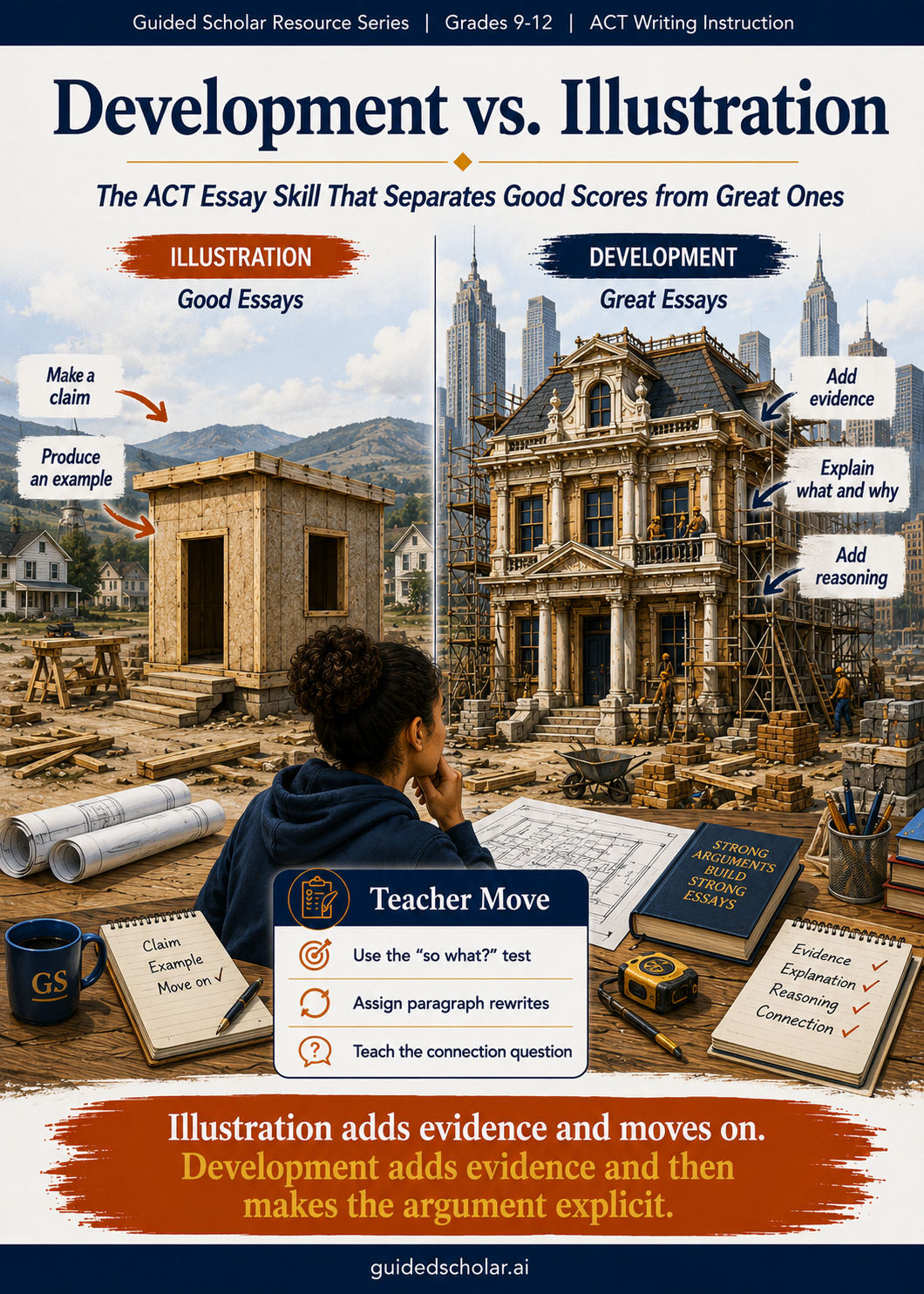
Illustration adds evidence and moves on. The student makes a claim, produces an example consistent with the claim, and proceeds to the next paragraph. The example does not contradict the claim, so it functions as support. But the connection between the example and the claim is never made explicit, and the reasoning that links them is never stated.
Development adds evidence and then makes the argument explicit. The student makes a claim, produces an example, explains what the example establishes, explains why that matters to the specific claim being made, and either addresses a complication or transitions to the next aspect of the argument. The difference between these two paragraph structures is not length. It is the presence of reasoning.
A student who writes “social media can hurt teenagers, for example, many students feel worse after using it” has illustrated the claim. A student who writes “social media can hurt teenagers when it turns ordinary life into a comparison contest: students may compare their normal day to carefully chosen pictures of everyone else’s best moments, which can make their own lives feel worse than they are” has developed it. The second version gives a reason, explains how the example works, and shows why it matters.
Why Illustration Is the Default
Illustration is the default because it is easier to execute under time pressure and because the five-paragraph essay structure does not require development in order to be complete. A student who has three body paragraphs each containing a topic sentence and two examples has produced a complete five-paragraph essay that illustrates a thesis. The form is finished and the content is present. He has not produced a developed argument, but nothing in the structure required her to.
The ACT rubric’s Development domain specifically targets this gap. The rubric distinguishes between essays where “reasoning is sound but limited” and essays where “reasoning is thorough and compelling.” Sound but limited means illustration: the reasoning is not wrong, it just never explains what the evidence establishes. Thorough and compelling means development: the reasoning says something that illustration alone could not establish.
The Paragraph-Level Diagnostic
Development problems almost always appear at the paragraph level before they appear in the essay as a whole. The diagnostic is simple: after each body paragraph, ask what the reader knows after the paragraph that she did not know before it. If the answer is that she has an example in support of the thesis, the paragraph illustrated. If the answer is that she understands a specific reason, consequence, or complication that develops the thesis’s meaning, the paragraph developed.
This paragraph-level check is the most efficient feedback tool for Development scores because it isolates exactly where reasoning stopped. A student who receives paragraph-level feedback identifying where illustration replaced development can revise that specific location rather than reconsidering the whole essay. The revision is finite and targeted, which makes it executable under the time constraints of test preparation.
What This Looks Like in Guided Scholar
Guided Scholar’s ACT mode delivers domain-level feedback on student essays with Development feedback specifically targeting the illustration-versus-development distinction. When a student’s paragraph drops an example and moves on, the feedback identifies the gap and gives a specific direction: what does this example establish, and why does that matter to the specific claim you made? The student can revise in response to that feedback before the session closes.
The teacher sees both the original essay and the revised version, making the development change visible. A student who received specific feedback on an illustration paragraph and produced a revised version that explains the reasoning rather than simply citing the example has demonstrated the skill. That demonstration is assessable in a way that a composite practice score alone does not provide.
Practical Starting Points for Teachers
- Use the “so what?” test after every body paragraph. After each piece of evidence, ask: so what? What does this establish about the specific claim? If the paragraph does not answer that question, it illustrated. Students who can apply this test in untimed revision can eventually apply it while writing.
- Assign paragraph rewrites before full essay practice. Give students an illustration paragraph and ask them to develop it by adding the reasoning. This targeted exercise produces faster skill development than full essay practice because it isolates the specific skill without requiring management of the whole essay simultaneously.
- Teach the connection question explicitly. For any piece of evidence, ask: what connects this evidence to the claim? Naming that connection is the act of development. Students who can identify the connection in untimed conditions are building the habit of providing it under time pressure.
- Score Development separately and before returning composite scores. Students who receive a specific Development score and a paragraph-level diagnosis of where development stopped can revise productively. Students who receive only a composite score cannot.
The Through Line
The development gap is the most consequential score gap for ACT Writing preparation because it is the gap between essays that are well-written and essays that are well-argued. Organization and Language Use are the domains most students can reach a functional score on with basic preparation. Development is where essays that score in the middle range stay in the middle range. It is also where targeted instruction produces the most significant improvement, because the skill is specific and teachable: explain what the evidence establishes and why it matters to the claim. That specificity makes it learnable.
ACT Inc., ACT Writing Test Rubric (2016); Hillocks, G., Teaching Argument Writing, Grades 6–12 (Heinemann, 2011); Twenge, J., iGen (Atria Books, 2017).