A high school junior produces a strong written argument for a research paper. Two weeks later she gives a presentation on the same research. The slides have no claim. The content is organized by topic. The conclusion says: “in summary, this is an important issue.” When her teacher asks why the presentation does not make the argument the paper made, the student says she thought presentations were different.
She is not wrong that presentations are different. She is wrong about what is different. The format changes. The academic task does not. A presentation that makes an argument, an essay that makes an argument, and a spreadsheet analysis that makes an argument are all doing the same thing: stating a specific, defensible position and developing it with evidence and reasoning. Most students have been taught each format as a separate subject with separate rules. None of them learned that all three share the same underlying requirement.
The Unified Skill
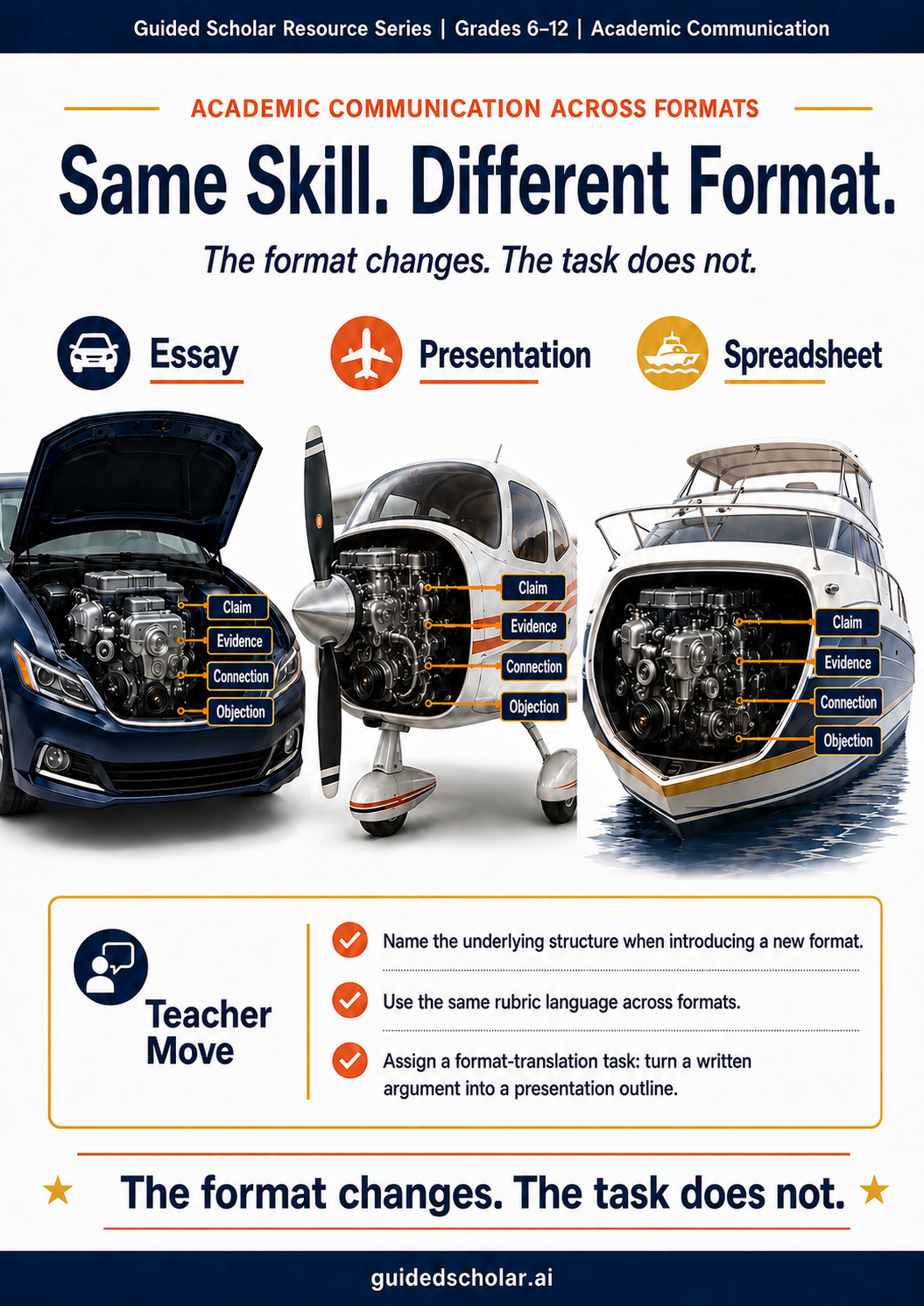
Every academic communication format requires the same foundational cognitive work: identify a claim the audience does not already accept and that the communication will establish; select evidence that supports that claim specifically, not evidence that relates to the topic generally; explain the connection between the evidence and the claim rather than leaving it implicit; acknowledge the most significant objection and address it.
These four requirements are the structure of any argument in any format. In a written essay, they appear in the thesis and body paragraphs. In a presentation, they appear in the opening claim and the supporting slide sequence. In a spreadsheet analysis, they appear in the written claim statement and the data explanation. The format determines how the elements are expressed. The requirement to include them does not change.
Why Transfer Does Not Happen Automatically
Research on transfer of learning is clear that skills developed in one context do not automatically apply in new contexts without instruction that explicitly names the connection. David Perkins and Gavriel Salomon’s foundational work on learning transfer (1988) distinguished between automatic transfer, which occurs through repetition in varied contexts, and deliberate transfer, which requires the learner to recognize an abstract principle and apply it consciously in a new setting.
Argument construction is a deliberate transfer skill. Students who have practiced writing arguments in essays will not automatically apply the same structure to presentations. They will apply whatever they know about presentations, which is typically: slides with bullets, delivered to the class. The instruction that produces transfer explicitly names the connection. The format is new. The underlying task is the same.
The Writing-to-Presentation Connection
The most direct transfer instruction for presentations is showing students that a presentation outline is an essay outline expressed in visual form. An essay has a thesis, body paragraphs, and a conclusion. A presentation has an opening claim slide, supporting evidence slides, and a closing synthesis. The one-to-one structural mapping is teachable and makes the transfer explicit.
The key move is requiring students to state the presentation’s claim in one sentence before building any slides. That sentence is the presentation’s thesis. Everything that follows develops it. Students who have been writing thesis-driven essays already know what this requires. What they need to be told is that the same requirement applies in the new medium.
The Writing-to-Spreadsheet Connection
The connection between written argument and data argument is less obvious to students and requires more explicit instruction. The claim the spreadsheet supports is the thesis. The data is the evidence. The explanation of what the data shows is the body paragraph. A student who understands this mapping already knows how to structure a data argument, because she has been structuring written arguments. What she needs is the instruction that names the connection.
The specific skill that requires naming is evidence evaluation: in writing, evidence is selected for relevance to the specific claim; in data work, specific rows, columns, or chart elements are selected for the same reason. A student who has been taught to choose evidence that supports the specific claim, not evidence that relates to the general topic, can apply the same principle to selecting which data to include in her analysis.
What This Looks Like in Guided Scholar
Guided Scholar’s Teach Me mode applies the same rubric-aligned feedback structure across written assignments, presentations, and spreadsheet analyses. The criteria are consistent across formats: is there a specific claim, does the evidence connect to it, does the development build? When a student moves from a writing assignment to a presentation assignment in the same class, the feedback criteria she has already internalized apply in the new context.
A teacher who can see a student’s argument development across formats, strong in written argument and defaulting to topic-organized bullets in presentations, has a specific instructional gap to address. The feedback in the presentation session can name the connection explicitly: the structure you used in your essay applies here. The visibility across formats makes that targeted instruction possible.
Practical Starting Points for Teachers
- Name the underlying structure explicitly when introducing a new format. When assigning a presentation or data analysis, tell students: the argument structure is the same as your written work. Claim, evidence, development. This single framing reactivates a skill students already have.
- Use the same rubric language across formats. If essay rubrics score claim clarity, presentation and spreadsheet rubrics should use the same term. Consistent language signals that the same skill is being assessed and builds the connection that produces transfer.
- Assign a format-translation task. Ask students to take a written argument they have already produced and translate its structure into a presentation outline or a data analysis framework. The translation requires identifying what the essay’s structure is doing and how to do the same thing in the new format.
- Debrief format differences alongside format requirements. After a presentation or spreadsheet assignment, ask: what was different about making this argument in this format? What stayed the same? The debrief builds the abstraction that drives transfer.
The Through Line
The student who disconnects her essay argument from her presentation structure and her spreadsheet analysis is doing exactly what her instruction has taught her to do: treat each format as a separate subject. The instruction that produces transfer names the underlying skill, demonstrates it in each format, and requires students to apply the same criteria each time. The format is the medium. The argument is the work. When students understand that distinction, the format changes but the task does not.
Sources referenced: Perkins, D. & Salomon, G., “Teaching for Transfer,” Educational Leadership (1988); Mayer, R., Multimedia Learning (Cambridge University Press, 2001); Atkinson, C., Beyond Bullet Points (Microsoft Press, 2007); Hillocks, G., Teaching Argument Writing, Grades 6–12 (Heinemann, 2011).